Your energy bill went up again. You blamed the rate increase. You blamed the summer heat. You might want to blame your roof instead. Most homeowners think of a roof problem as a leak problem. But the truth is that a damaged or deteriorating roof drives up your energy costs long before water ever stains your ceiling. Wet insulation, failed ventilation, hidden mold, and air leaks through the roof system all force your HVAC to work harder and run longer. This guide explains the five ways roof damage quietly raises your utility bill, what the warning signs look like, and how catching the roof problems early saves you thousands.
TLDR: A roof problem is an energy problem. Wet insulation loses up to 40 percent of its thermal resistance. Poorly ventilated attics reach 130 to 160 degrees in summer. Mold starts growing within 24 to 48 hours of water exposure. All of these conditions force your HVAC to work overtime. With Ameren Missouri summer bills up 34 percent since 2020, every efficiency loss costs more today than it did three years ago.
You have not changed your thermostat settings. You have not added any appliances. Your household routine is the same as last year. But your electric bill keeps climbing.
With Ameren Missouri raising rates 12 percent in June 2025, it is easy to assume the utility company is the whole explanation. But for many Southwest Missouri homeowners, part of that increase is coming from above. A compromised roof system quietly degrades your home’s thermal envelope, and the HVAC system absorbs the cost every hour it runs.
Here is exactly how that happens.
Wet Insulation: The R-Value Collapse
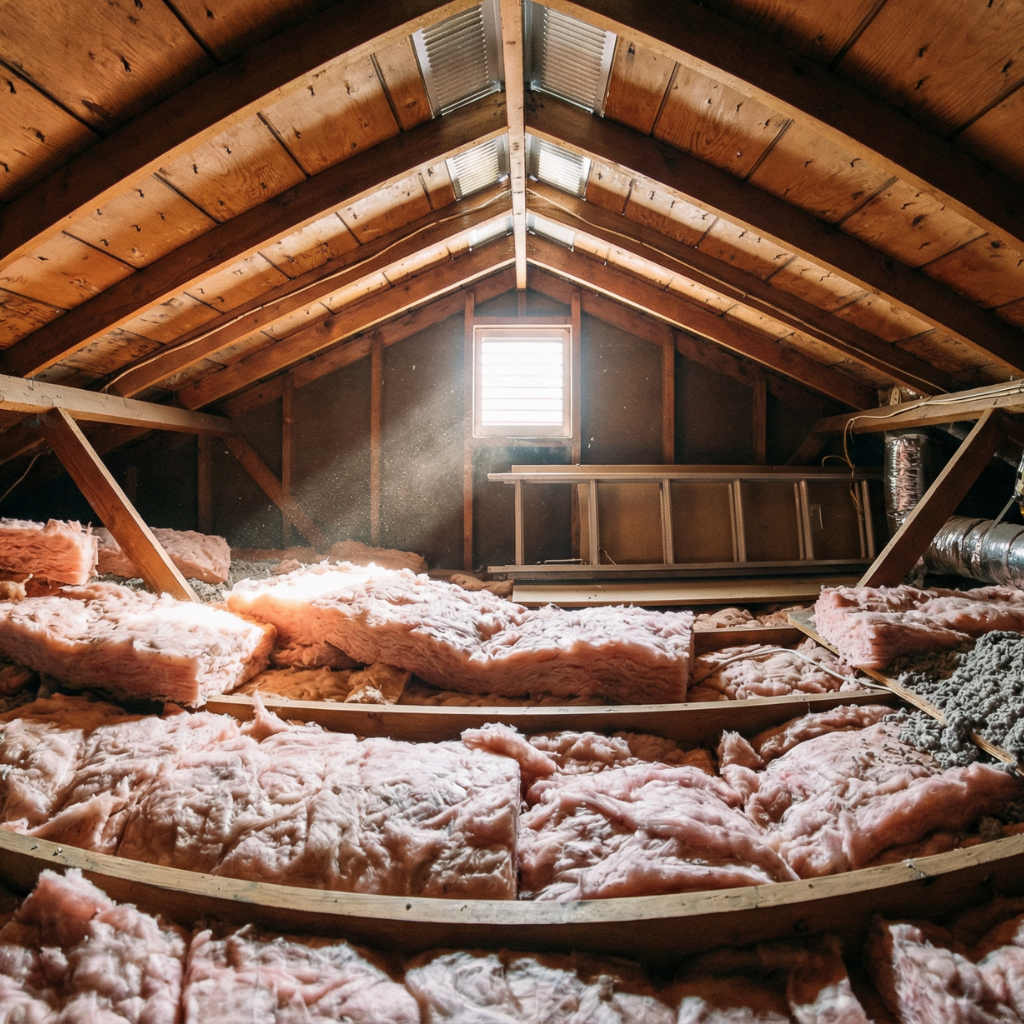
This is the most direct connection between a roof leak and a higher energy bill. Insulation works by trapping air, which is a poor conductor of heat. When a roof leak saturates insulation, water replaces that trapped air. Water conducts heat approximately 25 times more efficiently than air. The result is a collapse in thermal resistance.
Wet insulation loses up to 40 percent of its R-value when saturated. If your attic has R-30 insulation and a roof leak soaks a section, that area may drop to R-18 or lower. Your HVAC system runs longer cycles to compensate for the heat gain in summer or heat loss in winter. The bill goes up, but the damage is invisible. There is no obvious stain or drip. Just a higher number at the end of the month.
The secondary problem is permanent. Blown-in insulation compresses and settles under the weight of water. A three-foot cavity of blown-in insulation can settle to two feet, leaving the top third of the cavity completely bare. Even after drying, blown-in insulation does not re-expand. That uninsulated gap remains until the insulation is replaced.
Real example: A homeowner in Ava noticed their summer bills were running about $25 higher than the previous year. They assumed it was the rate increase. A Roov inspection found a failed pipe boot seal that had been allowing water into the attic for at least two seasons. The insulation in a 10-by-12-foot section was saturated and compressed. The pipe boot repair cost $275. The insulation replacement cost $600. The energy waste over those two years had already exceeded both.
Pro tip: If your energy bill has risen without a clear explanation, do not assume it is only the rate increase. A free roof inspection that includes an attic check can identify wet insulation and ventilation problems that are costing you money every month.
Failed Attic Ventilation: The Summer Heat Trap
A properly ventilated attic moves air through a continuous cycle. Cool air enters through soffit vents. Hot air exits through ridge vents. This keeps attic temperatures near the ambient outdoor temperature rather than trapping heat.
Without proper ventilation, summer attic temperatures reach 130 to 160 degrees. That heat radiates downward through the ceiling and into your living space. Your AC fights it all day.
The EPA and Energy Star confirm that homeowners can save 15 percent on heating and cooling costs by properly sealing and insulating their attics. The inverse is also true: a compromised attic system can add 15 to 20 percent to your bills.
For a Missouri homeowner spending $135 a month on electricity, with 35 to 40 percent going to cooling, that is roughly $47 to $54 a month on AC alone. A 10 to 15 percent reduction from proper ventilation saves $5 to $8 a month. The flip side: failed ventilation adds $5 to $15 a month during peak summer.
How roof problems cause ventilation failure: ridge vents clogged with debris or improperly sealed during prior roof work, soffit vents blocked by blown insulation migrating to the eaves, box vents damaged by hail or storm debris, and improper vent installation by a previous contractor.
Pro tip: Missouri’s humid climate makes ventilation especially critical. Without it, warm moist air is trapped in the attic, creating conditions for both thermal loss and mold growth. If your upper floors are noticeably hotter than your lower floors in summer, ventilation failure is one of the most likely causes.
Real example: A couple in Reeds Spring had their attic checked after their AC could not keep the upstairs below 78 degrees during a July heat wave. The Roov inspector found that the soffit vents on the south side had been completely blocked by blown insulation that had shifted over time. The ridge vent was intact, but with no intake air, it was not functioning. Clearing the soffits and installing baffles restored the airflow. Their upstairs temperature dropped 4 degrees within the first week.
Roof Leaks Lead to Mold, and Mold Makes It Worse
The EPA confirms that mold can begin growing on wet surfaces within 24 to 48 hours of water exposure. In a leaking attic, that timeline starts the moment water reaches the insulation or wood framing.
Here is how the mold timeline progresses after a roof leak. In the first 24 hours, moisture saturates building materials including drywall, insulation, and wood framing. Between 24 and 48 hours, mold spores colonize damp areas and begin multiplying. By 48 to 72 hours, visible mold spots may appear on exposed surfaces. After 72 hours, mold spreads into hidden cavities including insulation, wall bays, and air systems.
Mold itself does not directly raise your energy bill. But the conditions that allow mold to grow are the same conditions that drive up costs. Wet insulation, trapped moisture, and poor ventilation are responsible for both the mold and the energy waste. If you see mold in your attic, it is a signal that all three problems are already in play.
The health stakes add urgency. The EPA estimates that 4.6 million cases of asthma are linked to indoor mold exposure, about 21 percent of the total in the United States. The DOE’s Lawrence Berkeley National Laboratory found that building dampness and mold raised the risk of respiratory and asthma-related health outcomes by 30 to 50 percent.
The cost of ignoring attic mold grows fast. Average attic mold remediation runs $1,000 to $4,000. If mold reaches HVAC systems, costs can climb to $3,000 to $10,000.
Pro tip: A musty smell in the attic or upper rooms is not “just an old house smell.” It is likely active mold, which means active moisture, which means your insulation is compromised and your energy bills are already higher than they should be.
Air Leaks Through the Roof System
This mechanism is distinct from insulation loss. Air leaks are actual gaps in your home’s envelope where conditioned air escapes. In the roof system, the most common sources are failed pipe boot seals, gaps at chimney flashing, open joints at dormer and addition intersections, unsealed attic hatches or pull-down stairs, and gaps where ceiling meets walls in older homes.
Air leaks collectively account for 20 to 30 percent of total heat loss in an insulated home. Roof system gaps, including failed pipe boots, open flashing joints, and unsealed penetrations, are among the primary contributors. Even small gaps that are not visually obvious drive HVAC runtime up significantly.
What homeowners experience: uneven temperatures in rooms closest to the leak area, upper floors that are noticeably hotter in summer or colder in winter than the rest of the home, and HVAC that cycles constantly without reaching the target temperature.
Pro tip: If one room in your home is always a different temperature than the rest, the problem may not be the HVAC system. It may be an air leak in the roof system directly above that room. A professional inspection can pinpoint the source.
Real example: A homeowner in Willard had one upstairs bedroom that was always 5 to 6 degrees warmer than the rest of the house in summer. They assumed the ductwork was undersized. A Roov attic inspection found a gap at the roof-to-wall intersection above that room where a dormer had been added. Conditioned air was escaping directly into the attic space. Sealing the gap cost less than $300 and solved a problem they had lived with for years.
Ice Dams: The Winter Energy Signal
Ice dams form when heat escapes from the living space into the attic, warms the roof deck unevenly, melts snow on the upper portion of the roof, and that meltwater refreezes at the cold eaves. The result is a ridge of ice that traps water behind it.
The critical insight: ice dams are not a roofing problem. They are an insulation and ventilation problem that shows up on the roof. The heat loss that creates ice dams is the same heat loss that drives up your heating bill. Money is literally melting off your roof.
The secondary damage compounds the cost. Once an ice dam forms, water backs up and pushes under shingles, soaking decking and insulation. That restarts the entire cycle of wet insulation, reduced R-value, and higher bills.
Signs ice dams are a current problem: heavy icicles forming along roof edges or gutters in winter, uneven snow melt on the roof (faster at the peak, frozen at the eaves), water stains on ceilings or walls near exterior walls during or after a thaw, and higher heating bills compared to previous winters.
Pro tip: If you see large icicles hanging from your gutters every winter, do not assume that is normal. It is a sign that heat is escaping through your attic. Fixing the insulation and ventilation that cause ice dams will reduce your heating bills and prevent the water damage that follows.
The Cascade: How a $300 Repair Becomes a $5,000 Problem
This is the part most homeowners do not see until it is too late. A small roof problem does not stay small. It compounds.
| Stage | What Happens | Cost |
|---|---|---|
| A pipe boot seal fails | Water enters attic slowly, no visible signs inside | $150 to $400 repair |
| Insulation saturates | R-value drops 40%, HVAC runs longer, bill rises $15 to $30/month | Energy waste accumulating |
| Mold begins growing (24 to 48 hours) | Insulation degrades further, air quality declines | Not yet discovered |
| Structural damage starts | Wood rot in decking and rafters from ongoing moisture | $800 to $1,500 for decking |
| Full escalation | Decking replacement + mold remediation + months of wasted energy | $5,000 to $12,000+ |
The energy bill increase was the first signal. It appeared before the leak was visible, before the mold was smelled, before the ceiling stained. If the homeowner catches the roof problem at the first or second stage, a $150 to $400 repair prevents everything that follows.
Real example: A homeowner in Aurora ignored a gradually rising electric bill for two summers, assuming it was rate increases. When they finally noticed a small water stain on the guest bedroom ceiling, a Roov inspection revealed saturated insulation across a 15-foot section of attic, early-stage mold on the sheathing, and a failed chimney flashing that had been leaking for an estimated 18 months. The chimney flashing repair was $350. The insulation replacement was $900. The mold remediation was $2,200. The total came to $3,450, plus an estimated $500 to $700 in wasted energy over those 18 months. A $350 flashing repair caught at the first stage would have prevented the rest.
Warning Signs Your Roof Is Already Costing You Money
| Warning Sign | What It Indicates |
|---|---|
| Energy bill rising without a lifestyle change | Insulation loss or ventilation failure from water intrusion |
| Upper floors hotter or cooler than lower floors | Compromised attic insulation or air leaks |
| HVAC running constantly without reaching target temp | Thermal envelope breach in the roof system |
| Musty smell in attic or upper rooms | Mold present from ongoing moisture problem |
| Heavy icicles or uneven snow melt in winter | Heat escaping through attic, ice dam risk |
| Water stains on ceilings, even old or dry ones | Prior or ongoing leak has reached insulation |
| Visible mold on attic sheathing or rafters | Active moisture and ventilation problem |
| Condensation on the attic side of roof deck | Ventilation failure, moisture accumulating |
Pro tip: You do not need to see a leak to have a roof-related energy problem. If two or more of these signs apply to your home, schedule an inspection. The cost is $0. The savings from catching the problem early can be thousands.
What to Do About It
The fix follows the same logic as the problem: address the source first, then repair the damage.
Start with a professional inspection that checks more than just the shingles. A Roov inspection includes the attic space, insulation condition, ventilation function, and every penetration point. This is where the hidden problems get found.
If water intrusion is confirmed, fix the source. A failed pipe boot, lifted flashing, or damaged vent is usually a straightforward roof repair costing a few hundred dollars.
If insulation is compromised, replace it. Do not assume it will dry out and recover. Blown-in insulation that has been saturated and compressed does not return to its original performance.
If ventilation is blocked or damaged, restore it. Clear soffits, replace damaged vents, and confirm the ridge vent is functioning.
If mold is present, address it before closing up the attic. Mold remediation must happen after the moisture source is fixed, not before.
Pro tip: The cheapest energy upgrade in your home may not be a new thermostat or better windows. It may be a $200 flashing repair and a cleared soffit vent in your attic. Start with an inspection to find out.
The Missouri Context: Why This Matters More Than Ever
Missouri electricity costs are rising faster than inflation. Ameren Missouri summer bills rose 34.3 percent from 2020 to 2025, outpacing both the 25.4 percent inflation rate and the 32 percent wage growth over the same period. The 12 percent rate increase effective June 2025 added another $14 to $20 per month for the average residential customer.
At $135.68 per month average, every percentage point of efficiency loss costs more today than it did three years ago. A 10 to 15 percent energy waste from a compromised roof system now translates to $15 to $30 per month, or $180 to $360 per year. Combine that with the repair costs that escalate while the problem goes unaddressed, and the math is clear: catching a roof-related energy problem early is one of the most cost-effective decisions a Missouri homeowner can make.
For homeowners across Ava, Reeds Spring, Willard, Aurora, and all of Southwest Missouri, the spring and fall seasonal roof maintenance window is the best time to catch these problems before they compound through another summer or winter.
Frequently Asked Questions
Q: Can a roof leak really affect my energy bill?
Yes. A roof leak that saturates attic insulation reduces its thermal resistance by up to 40 percent. Your HVAC compensates by running longer, which drives up your bill. The leak does not need to be large or visible. Even slow water intrusion through a failed pipe boot or cracked flashing can saturate enough insulation to raise your monthly costs $15 to $30.
Q: How much can poor attic ventilation add to my energy bill?
Proper attic ventilation can reduce cooling costs by 10 to 15 percent during summer. The inverse is also true. If your ventilation is blocked or damaged, you could be paying 10 to 15 percent more on cooling. For a Missouri homeowner spending $50 a month on AC, that is an extra $5 to $8 per month during peak summer.
Q: Does attic mold increase energy bills?
Mold itself does not directly raise your bill. But the conditions that produce mold are the same conditions that waste energy. Wet insulation, poor ventilation, and trapped moisture are responsible for both the mold and the higher costs. If you have mold, you almost certainly have an energy problem too.
Q: How quickly does mold start growing after a roof leak?
The EPA confirms that mold can begin colonizing wet surfaces within 24 to 48 hours. In an attic environment with warm temperatures and organic materials like wood and insulation, conditions are ideal for rapid growth. This is why addressing water intrusion quickly is critical.
Q: What are the signs my roof is wasting energy?
The most common indicators are rising energy bills without a lifestyle change, upper floors that are noticeably hotter or cooler than lower floors, HVAC that runs constantly without reaching the set temperature, musty smells in the attic or upper rooms, and heavy icicles forming along the eaves in winter.
Q: How much does it cost to fix a roof-related energy problem?
It depends on what stage the problem has reached. A pipe boot seal replacement costs $150 to $400. Insulation replacement for a damaged section runs $500 to $1,500. Mold remediation averages $1,000 to $4,000 for attic-specific work. The earlier you catch it, the less it costs.
Q: Will a new roof lower my energy bills?
A new roof with proper underlayment, ventilation, and insulation restoration can meaningfully reduce energy costs, especially if the old roof had hidden leaks, failed ventilation, or degraded insulation. The improvement varies by home, but 10 to 20 percent cooling cost reductions are realistic when all components are addressed.
Q: Does Roov check insulation and ventilation during a roof inspection?
Yes. Roov’s inspections include a full attic check covering insulation condition, ventilation function, moisture signs, and every penetration point. This goes beyond just looking at the shingles. It identifies the hidden problems that affect both your roof’s lifespan and your energy costs.
Key Takeaways
A roof problem is an energy problem. Wet insulation, failed ventilation, mold, and air leaks all force your HVAC to work harder. The bill goes up before any visible leak appears.
Wet insulation loses up to 40 percent of its R-value. Water conducts heat 25 times more efficiently than air. Even a small leak can create a significant thermal gap in your attic.
Mold starts in 24 to 48 hours. Once water reaches organic materials in your attic, mold colonization begins almost immediately. By the time you smell it, the problem is established.
The cascade is real. A $150 pipe boot repair ignored for two seasons can become a $3,000 to $5,000 combination of decking replacement, mold remediation, and insulation restoration, plus hundreds in wasted energy along the way.
Missouri bills are rising faster than wages. With Ameren summer bills up 34 percent since 2020 and another 12 percent increase in 2025, every efficiency loss costs more than it did before.
A free inspection catches it early. Roov’s attic check identifies wet insulation, ventilation failures, and moisture problems before they escalate. The inspection costs nothing. The problems it prevents cost thousands.
Ready to Find Out If Your Roof Is Costing You Extra?
You now understand how roof problems drive up energy bills and why catching them early matters more than ever. The next step is finding out whether your roof is working for you or against you.
Roov is Southwest Missouri’s trusted roofing partner. We bring “Roofing with a Purpose” to every job. That means honest answers, quality materials, and a team that treats your home like our own. We are GAF Master Elite certified, CertainTeed ShingleMaster certified, and Owens Corning Preferred Contractor.
Here is what we offer:
- Free, no-pressure Roof Condition Reports with full attic check
- Inspections that cover insulation, ventilation, and moisture, not just shingles
- Expert assistance with insurance claims for storm-related damage
- Local crews who live and work in your community
Ready to get started? Contact us today:
Call: 417-370-1259
Email: [email protected]
We serve Ava, Reeds Spring, Willard, Aurora, and all surrounding Southwest Missouri communities. Schedule your free inspection today. Let’s find out if your roof is quietly raising your energy bill.
Roov | Roofing with a Purpose | Serving Southwest Missouri