
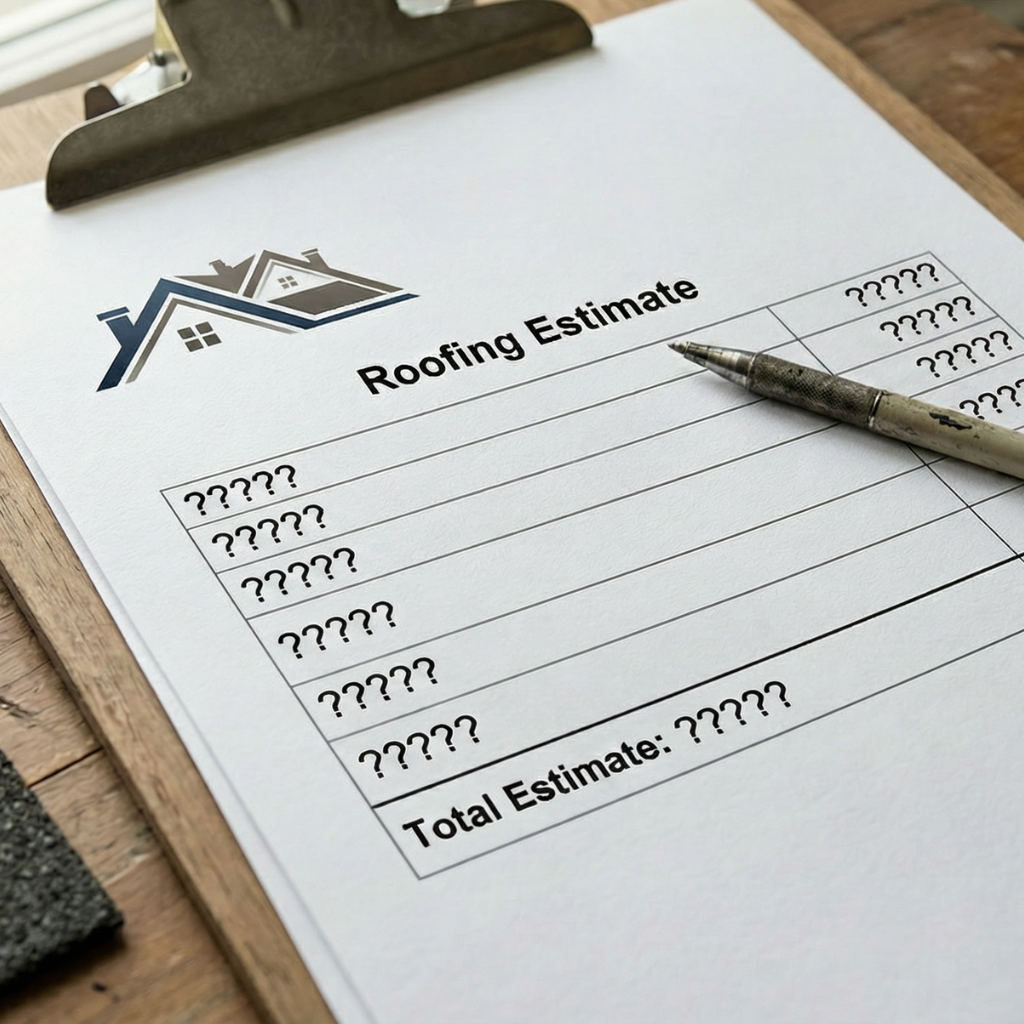
You got three estimates for your roof. The numbers are all different. One is a single page with a bottom line. Another is four pages of line items you have never seen before. You have no idea what you are actually comparing. That is exactly the problem this guide solves. A roofing estimate is the complete roadmap for your project. Every line item tells you something about what the contractor plans to do, what materials they will use, and where they might be cutting corners. This guide walks you through every line of your roofing estimate so you can read any estimate, compare bids fairly, and know exactly what questions to ask before you sign.
TLDR: A professional roofing estimate should itemize every material, labor component, and cost separately. If your estimate is a single lump sum with no breakdown, that is a red flag. The key items to look for are shingle brand and product, underlayment type, ice and water shield placement, flashing details, waste factor, decking repair pricing, warranty terms, and permit inclusion. Read on for the full line-by-line breakdown.
You are about to spend thousands of dollars on a project you cannot see from the ground once it is finished. The estimate is the only document that tells you what you are getting for that money. A good estimate is specific enough that another contractor could build the same roof from the document alone. A bad estimate is a number on a napkin.
Most homeowners compare estimates by looking at the bottom line. That is a mistake. A lower price does not mean a better deal if the contractor is skipping ice and water shield, reusing old flashing, or planning to skip the building permit. The only way to know what you are paying for is to read every line.
Here is how to do that.
What Is a Roofing Square?
Every roofing estimate starts with a measurement called a roofing square. One square equals 100 square feet of roof surface area. If a roofer says your roof is 22 squares, that means 2,200 square feet. Every material quantity, labor calculation, and cost on the estimate flows from this number.
Most residential roofs in Rogersville and across Southwest Missouri range from 18 to 24 squares. The average Missouri roof is about 1,974 square feet, or roughly 20 squares.
Pro tip: If two estimates show different square counts for the same roof, ask why. One may be using a satellite measurement (more accurate) and one may be eyeballing it from the ground. The square count should be consistent across all bids.
The Materials Section: What Every Line Means
Materials typically represent 30 to 50 percent of the total project cost. Each material should be listed separately with brand, product name, quantity, and unit price. Here is what to look for.
Shingles
The primary roofing material. Should specify the brand and product line (GAF Timberline HDZ, Owens Corning Duration, CertainTeed Landmark), color, wind rating, impact class, and quantity in squares. Architectural asphalt shingles run $100 to $250 per square for materials alone. Premium and impact-resistant options cost more.
Pro tip: “Architectural shingles” is a category, not a specific product. A bid that says “install architectural shingles” without naming the brand and product line is deliberately vague. The difference between a budget architectural shingle and a GAF Timberline HDZ is significant in both performance and warranty coverage.
Underlayment
The moisture barrier installed on the roof deck under the shingles. Two types should appear on a modern estimate.
Synthetic underlayment is the standard protection for the main body of the roof. It is stronger and lighter than old-style felt paper. Listed in squares.
Ice and water shield is a self-adhering rubberized membrane used at eaves, valleys, around penetrations, and any area prone to ice damming or water backup. Most Missouri building codes require it, and GAF warranty terms mandate it for full warranty coverage.
Pro tip: If an estimate only shows “underlayment” with no distinction between synthetic and ice and water shield, or does not mention ice and water shield at all, ask specifically where it will be installed. Some contractors skip it to lower the bid. That saves them money and costs you protection.
Starter Shingles
A special strip installed along the eaves and rakes before the first full shingle course. It provides a sealed edge that prevents wind-driven rain from getting under the first row. Should be listed as a separate line item with linear footage. Some contractors omit this and use cut field shingles instead. Ask specifically.
Drip Edge
Metal flashing that runs along the eaves and rake edges. It directs water off the roof edge and away from the fascia. Listed in linear feet. Should specify metal gauge and color. Another component that low-bid contractors sometimes leave out entirely.
Flashing
Metal used to waterproof every transition and penetration on the roof. A transparent estimate breaks flashing into specific types: step flashing at roof-to-wall intersections, counter flashing at chimneys, valley flashing in roof valleys, pipe boots around vent pipes, and kick-out flashing where the roof meets a sidewall.
If an estimate lists “flashing” as a single vague line item, or says “re-seal existing flashing,” that is a red flag. Flashing is the most common source of post-installation leaks, and reusing old flashing on a new roof defeats the purpose of the replacement.
Pro tip: Ask every contractor this question: “Are you replacing all the flashing or reusing the existing?” If they plan to reuse, ask why. In most cases, new flashing should be installed with a new roof.
Ridge Cap Shingles
Specially manufactured shingles that cover the ridge line. Should be listed separately from field shingles with brand and linear footage. GAF and other manufacturers require pre-manufactured hip and ridge shingles for full warranty coverage. Some contractors cut standard field shingles for ridge cap to save money. That approach voids enhanced warranty eligibility.
Ventilation
Any new ridge vents, off-ridge vents, or intake vent improvements should be itemized with quantity and product name. Ventilation is often where corners get cut because it is not visible from the ground after installation.
The Waste Factor: Why You Pay for More Than Your Roof Measures
Every estimate should include a waste factor. This is a percentage added to the raw square footage to account for cuts, overlaps, and material lost during installation. It is a legitimate cost, not padding.
| Roof Complexity | Standard Waste Factor |
|---|---|
| Simple gable or hip, minimal features | 5 to 10% |
| Moderate complexity (valleys, dormers) | 10 to 15% |
| Complex (multiple levels, skylights, chimneys) | 15 to 20% |
| Very complex (turrets, curved sections) | 20 to 25% |
Pro tip: If you see an estimate that charges for exactly the measured square count with no waste percentage, the contractor either plans to run short mid-job (and charge you extra for another material order) or is planning to pocket the overage. A good estimate shows the measured roof area and the ordered quantity with waste percentage applied.
Labor: The Largest Cost on the Estimate
Labor represents 50 to 70 percent of the total roof replacement cost. On most professional estimates, labor is built into each line item rather than broken out separately. Some contractors list it as a separate category. Either format is fine. What matters is that labor cost is not hidden.
| Labor Component | Cost Range (Missouri) |
|---|---|
| Shingle installation (new, labor only) | $50 to $90 per square |
| Tear-off and reinstall (reroof) | $75 to $125 per square |
| Steep pitch surcharge (8/12 or steeper) | Add 25 to 40% to base rate |
| Multi-layer tear-off | Add $25 to $75 per square per layer |
Real example: A homeowner in Highlandville received three estimates for the same 21-square roof. The lowest bid came in $2,800 under the other two. When they compared line by line, the low bid did not include ice and water shield, listed no waste factor, and planned to reuse the existing pipe boots and drip edge. The actual scope of work was not comparable.
Pro tip: The cheapest estimate is almost never the best value. Compare the scope of work line by line before you compare the bottom line.
Tear-Off and Disposal
Removing the existing roof and hauling away debris is always a separate cost. The estimate should show the number of layers being removed (two-layer tear-off costs more than one), disposal and haul-off fees, and a note about decking inspection during tear-off.
Missouri building code, following the International Building Code, generally requires full tear-off. Only one layer of roofing is permitted in most jurisdictions. A roof-over (installing new shingles directly on top of old ones) is often non-compliant and voids manufacturer warranties. If you are considering a full roof replacement in Southwest Missouri, your estimate should always include tear-off as a line item.
Pro tip: If a contractor suggests installing new shingles over your existing layer to “save you money,” understand the trade-offs. It may be cheaper today, but it voids your warranty, hides deck damage, and creates a heavier load on your structure.
Decking Repair: The Variable Wildcard
This is one of the most important and most unpredictable line items. When the old shingles come off, the crew inspects the roof deck (typically 7/16 inch OSB or 1/2 inch plywood) for rot, soft spots, and damage. No contractor can guarantee the exact amount of decking replacement needed before tear-off because the damage is hidden under the old shingles.
A transparent estimate shows a per-sheet price for replacement (for example, “$85 per sheet of 4×8 OSB if needed”), a statement that the price applies only to sheets found damaged during tear-off, and no obligation to replace more than what is actually compromised.
Pro tip: If an estimate says “wood repair as needed” with no unit price, that is a blank check. You have no idea what you will be charged once the old roof is off and you are committed. Always confirm a specific per-sheet price before signing.
Real example: A couple in Branson West was quoted a flat $12,500 for their roof replacement. During tear-off, the crew found eight sheets of rotted decking. The contractor charged $175 per sheet with no pre-agreed pricing. The final bill came in at $13,900. A per-sheet price agreed to upfront would have prevented the surprise.
Permits, Property Protection, and Warranties
Building Permits
In Springfield and across most of Southwest Missouri, a building permit is required for roof replacement. The contractor should pull the permit, and the cost should appear on the estimate. Standard residential reroof permits run $100 to $500 depending on the jurisdiction. If a contractor is not pulling a permit, that is a serious red flag. Unpermitted work can void your manufacturer warranty, create problems at resale, and lead to insurance claim denial.
Property Protection
A professional estimate describes how the contractor will protect your property during installation. This includes ground protection for landscaping and walkways, tarping of decks and patios, daily cleanup including a magnetic nail sweep, and how waste material will be staged and removed. If the estimate says nothing about property protection, ask.
Warranties
Every estimate should state two distinct warranty types. The manufacturer’s material warranty covers defects in the shingles and materials. Duration ranges from 25 years to Lifetime depending on the product. The contractor’s workmanship warranty covers installation errors. This is where quality varies dramatically. Some contractors offer one year. Roov, as a GAF Master Elite contractor, offers the GAF Golden Pledge roofing warranty with up to 50 years on materials and 25 years on workmanship.
Pro tip: “We guarantee our work” is not a warranty. It is a sentence. Ask for the specific term in years, what it covers, what it excludes, and who you call if there is a problem. Get it in writing on the estimate.
Overhead and Profit: The Insurance Claim Line Item
This line item appears almost exclusively on insurance claim estimates, and it confuses many homeowners. Overhead and profit (O&P) covers the contractor’s operating expenses (vehicles, tools, insurance, office staff, licenses) plus profit margin. It is typically calculated at 10 percent overhead plus 10 percent profit, equaling 20 percent of the total job cost.
When insurers pay a claim, they sometimes initially exclude O&P, arguing it is already built into unit costs. It generally is not. Homeowners and their contractors often have to specifically request that overhead and profit on roofing insurance claims be added to the insurance estimate.
A longstanding insurance industry practice called the “three-trade rule” holds that O&P is owed when three or more trades are involved in the repair. However, this rule has no binding legal authority in most states, and carriers often resist paying it regardless of how many trades are involved.
Pro tip: If you are filing an insurance claim for your roof, ask your contractor whether O&P is included in the insurer’s estimate. An experienced claim contractor like Roov knows how to identify when O&P is owed and how to supplement the estimate. This is one of the specific advantages of working with a contractor who handles roof insurance claim assistance regularly versus handling it alone.
Payment Schedule: What Is Normal
A professional estimate includes a clear payment schedule. The industry standard is a deposit of 10 to 30 percent upfront to order materials, sometimes a progress payment at material delivery, and final payment upon satisfactory completion and walk-through.
| Payment Red Flag | Why It Matters |
|---|---|
| More than 50% demanded upfront | Risk of contractor taking money and disappearing |
| Full payment before completion | No leverage if work is substandard |
| Cash only | No paper trail, potentially uninsured |
| No written payment terms | Dispute waiting to happen |
Pro tip: Never pay in full before the work is complete and you have done a final walk-through with the project manager. A reputable contractor does not need your full payment before the job is done.
The 8 Red Flags Before You Sign
These are the most important warning signs in any roofing estimate.
A lump sum with no itemization means you cannot compare, hold the contractor accountable, or know what is included. “Wood as needed” without a unit price is a blank check for add-on charges. No mention of ice and water shield signals a corner-cutting contractor. No permit included means the contractor may plan to skip it entirely. Warranty terms not specified in writing means “we guarantee our work” with no enforceable commitment. An unusually low total price signals inferior materials, an uninsured crew, or incoming hidden fees. A vague scope like “reroof as needed” provides no accountability. And payment terms requiring more than 50 percent upfront is a major storm chaser red flag.
How to Compare Multiple Estimates Side by Side
When you have two or three estimates in front of you, here is how to evaluate them fairly. Confirm the square count is the same across all bids. If not, ask why. Identify the shingle product in each bid by brand and product line. Confirm ice and water shield is present in all bids and covers the same areas. Check that all bids include drip edge, starter strips, and new pipe boots. Compare warranty terms side by side, both manufacturer years and workmanship years. Confirm all bids include permit pulling. And verify that payment schedules are reasonable.
Real example: A homeowner in Kimberling City got three bids after a hail storm. Two were within $800 of each other. The third was $3,200 lower. Line by line, the low bid used a different shingle brand with a shorter warranty, skipped ice and water shield in the valleys, and listed “reuse existing flashing.” When they compared actual scope, the two higher bids were essentially identical and the low bid was a different project entirely.
Pro tip: The goal is not to find the lowest price. The goal is to find the best value from a contractor who will do the work right, stand behind it, and be here when you need them. Read what should be included in a roofing estimate from Owens Corning for additional guidance on evaluating contractor proposals.
Frequently Asked Questions
Q: What should a roofing estimate include at minimum?
A professional estimate should include company information with insurance documentation, a full scope of work broken down by line item, materials listed by brand and product with quantities, labor costs, tear-off and disposal, decking repair pricing, permit, property protection plan, warranty terms for both materials and workmanship, and a payment schedule. If any of these are missing, ask why.
Q: How many estimates should I get before choosing a contractor?
Three is the standard recommendation. Fewer than three does not give you enough data to compare. More than five creates confusion without adding clarity. Focus on comparing the scope of work line by line rather than just the bottom-line price.
Q: What is a normal waste factor on a roofing estimate?
For a moderately complex roof with valleys and dormers, 10 to 15 percent is standard. Simple roofs may be 5 to 10 percent. Complex roofs with multiple levels, skylights, and chimneys can run 15 to 20 percent. If the estimate shows zero waste factor, ask how the contractor plans to handle material cuts and overlaps.
Q: Is it normal for decking repair cost to be unknown before tear-off?
Yes. Deck damage is hidden under the existing shingles and cannot be fully assessed until tear-off. A good estimate will show a per-sheet price for replacement so you know the cost per sheet if any are needed. A bad estimate says “wood as needed” with no pricing, which gives you no cost control.
Q: Should a roofing estimate include the building permit?
Yes. Most Missouri roof replacements require a permit. The contractor should pull it, and the cost should be listed on the estimate. If a contractor does not include the permit or suggests skipping it, that is a red flag for unpermitted work that can void warranties and cause problems during a future home sale.
Q: What is overhead and profit on an insurance claim estimate?
Overhead and profit covers the contractor’s operating costs and margin. It is typically 20 percent of the job total (10 percent overhead plus 10 percent profit). Insurance companies sometimes exclude it from their initial estimate. An experienced claim contractor knows when O&P is owed and how to request it be added.
Q: How much should I pay upfront for a roof replacement?
A deposit of 10 to 30 percent is normal to cover material ordering. Anything above 50 percent before work begins is a red flag. Final payment should happen after the work is complete and you have done a walk-through. Never pay in full before the project is finished.
Q: How do I know if a low estimate is too good to be true?
Compare the scope of work, not just the price. If the low bid is missing ice and water shield, uses a lesser shingle brand, reuses existing flashing, skips the permit, or has vague line items, it is not a comparable bid. A lower price with a smaller scope is not a savings. It is a different project.
Key Takeaways
A roofing estimate is not just a price. It is the complete plan for your project. Every material, every labor component, and every cost should be itemized and specific.
Compare scope before you compare price. Two estimates with the same bottom line can describe completely different projects. Read every line before you decide.
Watch for the red flags. Lump-sum bids, missing ice and water shield, “wood as needed” with no unit price, no permit, and vague warranty language are all signs of a contractor who is either inexperienced or deliberately cutting corners.
Overhead and profit matters on insurance claims. If your insurer’s estimate does not include O&P, an experienced contractor can identify and request it. This can add thousands to your claim payout.
The cheapest estimate is rarely the best value. A roof is a 20 to 30 year investment. The contractor who installs it correctly, uses quality materials, and backs the work with a real warranty is worth the difference.
Get a detailed, itemized estimate from Roov. We break down every line item, explain every material choice, and answer every question before you sign. That is what transparency looks like.
Ready to See What a Transparent Roofing Estimate Looks Like?
You now know how to read any roofing estimate line by line. The next step is getting one that actually gives you the detail you deserve.
Roov is Southwest Missouri’s trusted roofing partner. We bring “Roofing with a Purpose” to every job. That means honest answers, quality materials, and a team that treats your home like our own. We are GAF Master Elite certified, CertainTeed ShingleMaster certified, and Owens Corning Preferred Contractor.
Here is what we offer:
- Free, no-pressure Roof Condition Reports
- Detailed, itemized estimates with every line explained
- Expert assistance with insurance claims and O&P recovery
- Local crews who live and work in your community
Ready to get started? Contact us today:
Call: 417-370-1259
Email: [email protected]
We serve Rogersville, Highlandville, Branson West, Kimberling City, and all surrounding Southwest Missouri communities. Schedule your free inspection today. Let’s get you an estimate you can actually understand.
Roov | Roofing with a Purpose | Serving Southwest Missouri