
My Roof Is Leaking in Heavy Rain: What’s Causing It and What To Do Right Now
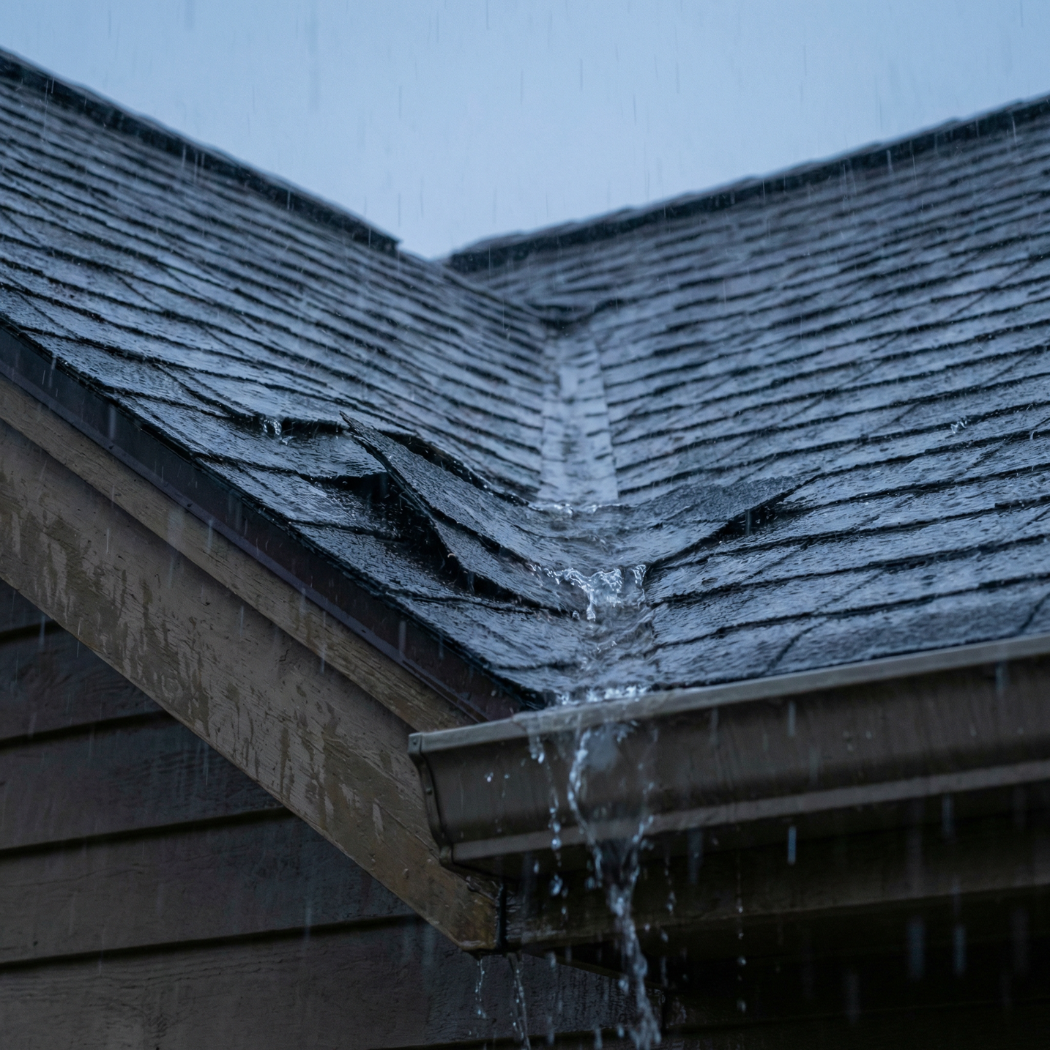
Water is coming through your ceiling. The storm is still going. You do not know where it is coming from or how bad it is going to get. This guide tells you exactly what to do in the next 30 minutes to protect your home, then walks you through the most common causes of heavy-rain-only leaks in Southwest Missouri so you understand what you are dealing with and what needs to happen next.
TLDR: An emergency roof leak in Aurora MO or anywhere across Southwest Missouri follows a predictable pattern: contain the water inside, check the attic safely, document what you see, and call a roofer as soon as the storm allows. Most heavy-rain leaks trace back to five failure points, and most have nothing to do with your shingles. A free inspection from Roov finds the actual source and stops the guessing.
Take a breath. A single leak during a storm is frightening, but most leaks are contained to one entry point and one path through the structure. Your first job is not to figure out what is wrong with the roof. Your first job is to control the damage inside your home right now.
First 30 Minutes: What To Do Right Now If Water Is Coming In
Work through these steps in order. Do not skip ahead to the roof.
Step 1: Stay away from electrical hazards. Water and electricity are your most immediate danger. If the leak is near a light fixture, ceiling fan, or outlet, do not touch those fixtures. Do not stand directly under the drip and reach for a light switch. If water is tracking along a ceiling toward an electrical panel or fixture, turn off the breaker for that circuit or the whole panel if needed. According to OSHA’s guidance on electrical hazards near water, moist or wet skin acts as a conductor and dramatically lowers resistance to electric current. A dripping ceiling near wiring is not a minor inconvenience. Treat it as a hazard first.
Step 2: Watch the ceiling for sagging or bubbling. Drywall absorbs water and can hold a substantial amount before it gives way, but when it goes, it comes down fast. If you see a section of ceiling that is visibly bowing or has a water blister forming, place a bucket beneath it and carefully puncture the lowest point with a screwdriver. This releases the water in a controlled stream instead of a sudden collapse. Move any furniture, rugs, and belongings out from under the affected area.
Step 3: Contain the water. Place buckets, pots, or bins directly under any active drip points. Lay towels, plastic sheeting, or a tarp over flooring and furniture in the affected area. If the leak is in a carpeted room, the padding underneath saturates quickly and will grow mold if it does not dry completely. Get the furniture off the carpet if possible.
Step 4: Do a safe attic check if you can get there without risk. If you can access your attic through a pull-down stair or a closet hatch without exposing yourself to the storm, take a flashlight and look. Do not step on insulation or walk on the ceiling joists. You are looking for the active wet spot, a trail of water on a rafter or roof deck, or daylight visible through a gap. Finding the general source area now gives a roofer a head start when they arrive.
Step 5: Photograph everything before you clean anything up. Take wide shots and close-up shots of the stain, the drip point, any sagging drywall, and any visible water in the attic. Note the time and write down what the weather conditions are, heavy rain, wind direction, or both. According to NAIC’s guidance on documenting damage for insurance claims, documenting losses before cleanup is essential, as claims can be denied for insufficient evidence. Your phone camera is doing important work right now.
Step 6: Do not go on the roof. A wet roof during an active storm is one of the most dangerous places a homeowner can be. You will not be able to identify the source in those conditions, and even professional roofers do not work on wet pitched surfaces during active weather. The temporary fix you might attempt is likely to be ineffective and could injure you.
Step 7: Call Roov when the storm allows. You do not have to wait until the sun comes out. If the rain is slowing or the worst of the storm has passed, call 417-370-1259 and describe what you are seeing. Roov triages emergency calls and can advise on whether immediate temporary protection is needed before a full inspection.
| Situation | Do This Now | Do Not Do This |
|---|---|---|
| Water dripping near a light fixture or outlet | Turn off that circuit at the breaker | Touch the fixture or stand directly under it |
| Ceiling visibly sagging or bowing | Puncture the low point to release water in a controlled stream; place bucket below | Wait for it to collapse on its own |
| Active drip on hardwood or carpet | Place bucket; lay plastic sheeting; move furniture | Assume it will dry out without intervention |
| You want to see the source from outside | Look from the ground; binoculars if helpful | Climb onto a wet roof during or right after a storm |
| Storm is passing and leak seems contained | Document with photos; call Roov to schedule inspection | Assume the leak is fixed once the rain stops |
Pro tip: Take your photos before you place the bucket. The drip trail on the ceiling and the pattern of the wet spot are part of the diagnostic picture. A roofer looking at your photos can often narrow down the source before they ever get on your roof.
Why Your Roof Only Leaks in Heavy Rain
If your roof leaks during a hard downpour but stays dry during ordinary rain, you are not imagining it. That specific pattern is one of the most common calls Roov receives, and it is almost always explained by one of three physical conditions.
Volume overflow. Roof valleys, gutters, and flashing details are designed to handle typical rainfall rates. A heavy Missouri spring storm can deliver two to three inches of rain in less than an hour. At that volume, a valley that works fine at normal rates can overflow at the edges and push water under the shingles. A gutter that drains adequately in a moderate shower backs up completely in a downpour, overflowing onto the fascia and potentially pushing water under the first shingle course at the eave.
Wind-driven rain. Southwest Missouri storms frequently combine heavy rain with sustained winds of 30 to 50 miles per hour. Wind-driven rain does not fall vertically. It approaches the roof at an angle, and it finds gaps that vertical rain never touches. A section of step flashing along a dormer wall that is barely adequate against straight-down rain is completely overwhelmed when rain is driving horizontally against it. This is why a homeowner might live in a house for years with no leak, then experience a storm that soaks one specific wall from a specific direction and suddenly has water inside.
Saturated underlayment and marginal seals. The underlayment is the water-resistant layer between your shingles and the roof deck. When a seal is marginal, perhaps a pipe boot collar that is cracked but not completely open, it holds through light rain but wicks water through during extended heavy exposure. The underlayment gets saturated after 30 or 40 minutes of hard rain and eventually passes moisture through to the deck. This produces a leak that starts 20 to 30 minutes into a storm, not at the first raindrop.
Pro tip: When you call for an inspection, tell the roofer specifically that your roof only leaks in heavy rain or only during certain wind directions. That detail narrows the likely source significantly before any inspection begins and helps a trained technician know exactly where to look first.
The 5 Most Common Heavy-Rain Leak Sources in Southwest Missouri
1. Chimney and Sidewall Flashing
Chimney flashing is the most frequently cited source of heavy-rain leaks in older Missouri homes. The chimney is a large vertical structure that interrupts the roof plane on all four sides, and every one of those joints requires flashing to remain sealed. In the typical Southwest Missouri home, the counter flashing on the upslope side of the chimney is embedded in a mortar joint. When that mortar cracks from age or freeze-thaw movement, a gap opens at the top of the flashing. Vertical rain runs off the shingles and misses that gap entirely. Wind-driven rain hits the vertical face of the chimney, runs down the brick, and enters the gap directly.
Why heavy rain exposes it: the mortar crack may be a fraction of an inch. It takes high-volume, directional water to find that opening consistently. Once it does, the water runs behind the step flashing and down the inside of the chimney framing, appearing on the ceiling near the fireplace or on an interior wall below the chimney.
What it can cause if ignored: rot in the wood framing adjacent to the chimney, water damage to the ceiling and drywall, and in extended cases, compromised structural members near the chimney base.
Pro tip: A ceiling stain that appears directly beside or below the chimney after wind-driven rain is almost always a flashing problem, not a shingle problem. The stain location reflects where the water ended up after traveling through the structure, not where it entered the roof.
2. Pipe Boots and Vent Penetrations
Every plumbing vent, exhaust vent, or conduit that passes through your roof creates a penetration. Each penetration is sealed with a collar or boot, typically a rubber gasket on a metal base flange. According to GAF’s guide on roof vent pipe leaks, plumbing vent pipe penetrations are among the most common sources of roof leaks, and failure usually stems from degraded collars or improper installation. In Missouri’s heat and UV intensity, rubber collars can begin cracking within 10 to 15 years. The crack may be minor, barely visible from the ground, but under sustained heavy rainfall, water enters around the pipe and runs along the underside of the roof deck until it finds a path down.
Why heavy rain exposes it: a minor crack in the collar holds against brief or light rain. Sustained downpour saturates the area and pushes water through the gap by volume and pressure.
What it can cause: concentrated water infiltration directly above living space, with staining on the ceiling below the vent location.
3. Valleys and Low-Slope Areas
A roof valley is the V-shaped channel where two roof slopes meet. All the water from both slopes funnels into that single channel. In normal rain, valley flashing handles it without difficulty. In a heavy downpour, the volume can exceed what the channel manages cleanly, and water backs up at the edges and runs under the adjacent shingles.
Flat or nearly flat roof sections present a related problem. Southwest Missouri homes with shed additions, garage bump-outs, or dormers often have a short section where two slopes meet at a very shallow angle. That section drains slowly and can pond water during heavy rain. If the underlying flashing or underlayment is compromised, that standing water eventually finds its way through.
Why heavy rain exposes it: at normal rainfall rates, the valley clears before overflow occurs. At high rates, the valley cannot clear fast enough and water backs up laterally.
What it can cause: water infiltration along the entire length of the valley, affecting a wide section of ceiling below rather than a single point.
Pro tip: If your ceiling stain is elongated rather than a spot, running roughly parallel to a roof ridge or valley line, suspect valley overflow or a compromised valley flashing rather than a point source like a pipe boot.
4. Roof Edge and Backed-Up Gutters
Clogged or poorly sloped gutters are the most preventable source of heavy-rain leaks. When a gutter fills with debris, water backs up during a hard rain and overflows rather than draining to the downspout. Some of that overflow runs down the exterior wall. But some of it soaks into the top edge of the fascia and wicks under the first course of shingles at the eave. Water that travels under the shingles at the eave line saturates the underlayment and can appear on the ceiling of the room directly below the eave.
Why heavy rain exposes it: a partially clogged gutter may drain slowly in a light rain before the section fills completely. In a hard downpour, the gutter reaches capacity almost immediately and overflows for the duration of the storm.
What it can cause: rot in the fascia, damage to the first courses of shingles, saturated roof decking at the eave, and ceiling staining in rooms near exterior walls.
5. Skylights and Satellite Dish Penetrations
Skylights are sealed on four sides with step flashing woven into the shingles and sealant caulk at the frame perimeter. Both elements degrade over time. A skylight that has been in place for 15 years likely has caulk that is cracked, and the step flashing may have separated from the curb slightly through repeated thermal expansion and contraction.
Satellite dishes and antenna mounts present a similar problem. Any lag bolt driven through the roof deck to mount a dish creates a penetration that requires proper sealing. Many older dish mounts were installed without proper flashing, and the sealant around them has long since cracked. Heavy rain finds those bolt holes reliably.
Why heavy rain exposes it: marginal seals hold against light rain but saturate and pass water through under sustained heavy exposure.
What it can cause: a ceiling stain directly below the skylight, often appearing to grow or darken during a storm and then dry out partially between rain events.
Temporary Fixes That Are Safe and Ones You Should Never Try
During and immediately after a storm, your options for addressing the leak source from the outside are extremely limited and should be. The safety risk is real and the value of most exterior quick fixes is minimal. Focus on interior containment first.
| Situation | Safe Temporary Step | What Not To Do | When To Call Roov Immediately |
|---|---|---|---|
| Active drip from ceiling | Bucket under drip; plastic sheeting over belongings; puncture sagging drywall blister if present | Ignore it and hope it stops | Ceiling is sagging broadly, not just a blister; leak is near electrical |
| Leak near a skylight from inside | Contain below; photograph the water path; note whether it tracks straight down or at an angle | Climb on the roof during or right after rain | Multiple entry points visible or water spreading across ceiling |
| Gutter overflow visible from ground | Clear the downspout opening from the ground with a pole or hose if safe | Stand on a wet ladder in active rain to clear the gutter | Water is entering at multiple eave locations simultaneously |
| Leak stopped after rain but stain visible | Document with photos; do not wash or paint the stain | Assume the stain means the leak fixed itself | You see mold, the stain is growing, or there is a musty smell in the attic |
| Attic shows wet rafter or deck section | Note the location relative to roof features; photograph; place a bucket if volume warrants | Step on ceiling drywall or insulation to get a closer look | Structural wood is visibly bowed, soft, or crumbling |
Safe temporary options for a homeowner after the storm has passed:
Placing plastic sheeting over the interior area below a known leak point is always appropriate. If you can access your attic safely, placing a bucket or large bin under the wet section of roof deck catches drips and prevents them from spreading to ceiling drywall. Beyond that, interior containment is the right scope.
Tarping a roof is a legitimate temporary measure, but it should only be attempted by someone who has done it before, on a section they can safely reach from a ladder at the eave or a low-slope section, and only after the storm has passed and the roof surface is dry enough to walk safely. An improperly secured tarp can cause more damage than the original leak if it shifts during the next wind event. If you are not experienced with this, call Roov and we will handle it.
What you should never attempt:
Do not walk a wet or damp pitched roof under any circumstances. Asphalt shingles are extremely slippery when wet, and a fall from a residential roof height is life-threatening. Do not attempt to tear up shingles or flashing to find the source on your own. The water entry point is almost never directly above the ceiling stain, and opening up the roof without knowing what you are doing creates new leak pathways. Do not apply spray foam, roofing tar, or caulk to the roof surface as a permanent solution. These materials may seal a surface temporarily but they do not address the underlying failure and often complicate the correct repair when a professional arrives.
Pro tip: Before attempting any temporary exterior work after a storm, give the roof at least an hour to dry after rain stops. Even partially damp asphalt shingles have significantly reduced traction compared to dry surfaces.
Pro tip: If you apply a temporary caulk or sealant patch yourself, tell the roofer exactly where you applied it and what product you used. It helps them understand the full picture and avoids situations where a temporary patch masks the actual source during the professional inspection.
When an Emergency Is Truly an Emergency
Not every active leak requires a same-day emergency call. Knowing the difference helps you stay calm and act appropriately.
The table below helps you calibrate urgency so you respond proportionally.
| What You See | Urgency Level | First Action |
|---|---|---|
| Single drip, no electrical nearby, small stain | Low to moderate | Contain with bucket and plastic; call Roov to schedule next-day inspection |
| Drip near light fixture, fan, or outlet | High | Turn off the circuit at the breaker immediately; call Roov same day |
| Ceiling sagging or bowing visibly | High | Puncture the low point to release water; do not stand below it; call Roov same day |
| Multiple active drip points across different rooms | High | Contain each point; call Roov immediately for emergency triage |
| Water running along a wall toward an electrical panel | Emergency | Shut off power at the main breaker; leave the area; call immediately |
| Drip stopped when rain stopped; stain visible | Low | Document with photos; schedule inspection before the next storm |
Call immediately and treat it as urgent if:
The water is near any electrical fixture, outlet, or panel. Multiple leak points are active simultaneously, not just one drip but water tracking in from two or three locations. The ceiling is showing broad sagging, not just a localized water blister. You can hear structural cracking or see visible deformation of the ceiling structure. Water is entering in a volume you cannot manage with buckets and containment. There is a lightning risk and you have reason to believe the structure has been struck.
You can wait until the storm passes and call for a next-day inspection if:
The leak is a single, contained drip point away from any electrical. The water is manageable with containment and the ceiling shows only a stain, not sagging. The leak has slowed or stopped as the rain lightened. You have taken photos, moved belongings, and the situation is stable.
The important thing in the second scenario is that stable does not mean resolved. A leak that stops when the rain stops has not fixed itself. The gap that let water in is still there. The ceiling stain will appear again in the next hard rain if the source is not addressed.
Pro tip: A small ceiling stain that appears after heavy rain and then dries out should not be painted over or ignored. It is a record of a water entry event. Get the inspection done before the next storm.
Pro tip: If the leak is actively dripping and the rain is still going, a folded towel placed in the bucket reduces splashing and keeps the bucket from overflowing as quickly as an empty container would.
Pro tip: If the stain is near an air return vent, ceiling fan housing, or recessed light, do not wait for the next rain to see if it repeats. Have it inspected now. Water near those fixtures is an electrical hazard even after the rain stops.
How Roov Handles Emergency Leak Calls in Southwest Missouri
When you call Roov during or after an active leak situation, the first thing that happens is a phone triage conversation. We ask where the leak is, what it looks like, whether there are any electrical concerns, and whether the storm is still active. Based on that, we advise you on immediate interior steps if you have not already taken them and schedule either a same-day emergency response or a next-day inspection depending on conditions and urgency.
When conditions allow us on the roof safely, the inspection covers the full roof system with attention to the specific failure points described in this article: chimney and sidewall flashing, pipe boots and vent penetrations, valleys and low-slope areas, roof edge and gutter conditions, and any skylights or penetrations. We photograph every relevant detail and include the findings in a written Roof Condition Report.
If temporary protection is warranted, meaning the damage is significant enough that waiting for a full repair would allow continued water entry, we handle the tarping or temporary sealing as part of the service. We do not leave a home exposed if we can prevent it.
Roov will tell you honestly whether the source of your roof leaking in heavy rain needs a targeted repair or whether the conditions we find suggest a broader issue. We are not going to recommend a full replacement when a repair will do. That is what “Roofing with a Purpose” means in practice.
Real example: An Aurora homeowner called Roov during a spring storm after noticing water dripping at the ceiling near the fireplace. Roov triaged by phone: the drip was away from electrical, the stain was small and contained, and the storm was beginning to pass. We scheduled a next-morning inspection. The inspection found the counter flashing on the upslope side of the chimney had separated from the mortar joint, a classic freeze-thaw failure on a 16-year-old home. A targeted chimney flashing repair stopped the leak. The homeowner had been assuming for two years that the fireplace was leaking from above. It was the flashing the whole time.
Real example: A homeowner in Nixa had a ceiling stain that appeared directly below a bathroom exhaust vent, but only during hard rain with a north wind. Why does my roof leak only when it rains hard from the north? The inspection found the pipe boot collar on the vent had cracked and partially separated from the base flange. Normal rain ran off the roof without entering the gap. Wind-driven rain approaching from the north hit the gap at an angle that drove water directly into the opening. A pipe boot replacement fixed it in under an hour.
Real example: A homeowner in Republic had a water stain that appeared at the outside wall of a first-floor bedroom directly below the roofline. The ceiling stain after rain had been growing slowly over two seasons. The inspection found the gutter above that section was completely clogged and had been overflowing consistently in every significant rain event. The overflow was saturating the fascia and wicking under the first shingle course at the eave. The gutter was cleared, the fascia was replaced where rot had developed, and the drip edge was reset properly. No more stain.
Real example: A homeowner in Marshfield had a leak that appeared in the spare bedroom only when rain came from the southwest during heavy spring storms. It had happened three years in a row, always the same stain in the same corner, always after a specific wind direction. Roov found that the sidewall step flashing along the adjacent dormer had separated from the wall surface on the southwest face. The gap was less than half an inch at its widest. Straight-down rain never reached it. Southwest wind-driven rain entered it with every major storm. A step flashing repair sealed the gap permanently.
Real example: A Springfield homeowner had a satellite dish mounted on the roof near the back slope ridge. The dish had been there for 12 years. The homeowner started noticing a ceiling stain in the office below it after hard rains about 18 months ago. The stain dried after each storm and never seemed urgent. By the time Roov was called, the water had been wicking along the same rafter for 18 months. The roof deck below the dish mount was soft and partially delaminated in a 3-foot radius around the bolts. The dish had been installed with lag bolts driven directly through the shingles and deck with only roofing caulk as a seal, and that caulk had cracked years earlier. The repair required replacement of the deck section, proper flashing, and new shingles. Catching it after the first stain appeared would have been a $400 repair. Waiting 18 months turned it into a $2,200 repair.
What to Document Before the Roofer Arrives
Good documentation speeds up the inspection and strengthens any insurance claim. You do not need professional equipment.
Take wide-angle photos of the stain from across the room and close-up photos of the drip point. Note the exact storm date and time and whether the leak started immediately when the rain began or 20 to 30 minutes into the storm, since that timing detail helps diagnose whether the source is a direct gap or a saturated underlayment issue. Record whether the rain was heavy and straight down or heavy and wind-driven, and from which direction if you know it. Note whether this is the first time you have seen this stain or whether it has appeared after previous storms.
If you can access your attic safely, photograph the wet area from below the roof deck, including any water trails running along rafters. The trail runs uphill toward the source, so the highest wet point on the rafter is usually the closest to where the water entered.
The table below summarizes what to document and why each piece of information matters.
| What to Document | How to Capture It | Why It Matters |
|---|---|---|
| Active stain or drip point | Wide shot and close-up photos with phone camera | Establishes location and severity at time of event |
| Storm date and time | Written note or phone note with timestamp | Links damage to a specific weather event for insurance |
| Rain type and direction | Note whether wind-driven, which direction, how heavy | Helps diagnose whether source is a gap that only faces a certain direction |
| Lag time before leak started | Note whether drip began immediately or 20 to 30 minutes into the storm | Distinguishes direct gaps from saturated underlayment pathways |
| Attic wet spots | Flashlight photos of wet rafters or roof deck | Shows water travel path; highest wet point is closest to entry |
| Prior stain history | Any previous stains in same location | Confirms a chronic leak vs. a first-time event |
Pro tip: A time-stamped photo taken during the storm is more valuable than one taken the next day once the stain has partially dried. Take the photo during the event even if the image is not perfect.
Pro tip: Write the storm date on a piece of paper and photograph it next to the ceiling stain.
Pro tip: If you have documented previous stains in the same area, include those old photos in what you share with Roov. A stain that has appeared after two or three different storms tells a different story than one that appeared once, and it matters for both diagnosis and insurance purposes. That combines your documentation into a single image that is hard to dispute during a claim review.
Frequently Asked Questions
Q: My roof only leaks when it rains hard. Is that normal? No. A properly installed and maintained roof should not leak regardless of rain intensity. A heavy-rain-only leak means the roof has a marginal failure point that holds under low-volume conditions but opens under high volume or wind-driven rain. Common culprits are flashing gaps at chimneys or pipe boots, valley overflow in downpours, and gutters backing up at the eave. The fact that it only happens in hard rain does not make it a minor problem. It means the failure point exists and needs to be found.
Q: Will one storm leak ruin my ceiling? A single contained drip from one storm event is unlikely to cause structural damage, but it does saturate the drywall and insulation in that area. If the drywall dries out completely and no mold develops, the ceiling may just need painting after the repair is done. The concern is repeat events. Every subsequent storm that produces the same leak adds moisture to the same area, and after two or three events the drywall paper and insulation become mold-prone. Address the leak source before the next rain.
Q: Can I just paint over a water stain once it dries? Not without applying a stain-blocking primer first. A standard latex paint will not cover a water stain permanently. It will bleed through within a few days or after the next temperature change. More importantly, painting over a water stain without addressing the source just hides the record of a water event. When the leak recurs, you lose the ability to see how old and how frequent the staining is, which matters both for diagnosis and for any insurance documentation. Fix the leak, allow the ceiling to dry completely, apply a shellac-based or stain-blocking primer, and then paint.
Q: Do I have to wait until it stops raining to call a roofer? No. Call during the storm if the situation is urgent or involves electrical hazard, structural concerns, or multiple active leak points. For a contained single drip, call as the storm is winding down. Roov triages calls and can advise on immediate steps by phone before conditions allow an on-roof inspection. Describing what you are seeing in detail, the stain location, proximity to electrical, whether it is dripping actively or just staining, gives us what we need to prioritize correctly.
Q: Does homeowners insurance cover leaks from heavy rain? It depends on the cause. Standard Missouri homeowners policies cover sudden and accidental water damage from a specific storm event. If the leak is tied to a hail or wind event that damaged flashing or a pipe boot, that damage is typically covered. If the leak is from gradual deterioration, age, or deferred maintenance, insurers generally treat it as a maintenance issue and decline the claim. The key is documentation, specifically the storm date, the timeline of when the stain appeared, and a professional inspection report that identifies the cause. Roov documents cause-of-loss findings in every Roof Condition Report, which gives you what you need if a claim is appropriate.
Q: How much does emergency roof leak repair usually cost in Southwest Missouri? A targeted repair, addressing a single failed pipe boot or a section of chimney flashing, typically runs $350 to $600. Valley flashing repairs or repairs that involve removing and reinstalling shingles run higher depending on the scope. If the inspection finds that the root cause is end-of-life conditions across the full roof rather than a single failure point, that changes the conversation toward replacement, and Roov will tell you that directly. Emergency tarping, if needed before a full repair is possible, is handled as part of the service. We will not charge you for a temporary protective measure and then use that as leverage to sell a replacement.
Q: What if the leak stops after the rain and I cannot find a stain? That situation deserves inspection as much as an obvious drip. Water that enters through a marginal seal can travel along rafters, down the inside of wall cavities, or across the underside of the roof deck for several feet before it drips into visible space. A homeowner who hears dripping in the attic but finds no ceiling stain may have water running along a rafter toward a wall cavity instead. Schedule an inspection at the next opportunity, describe the attic sound in detail, and let a professional trace it before the next storm does it again with more volume.
Q: What should I do about my wet insulation in the attic? Insulation that gets wet in a leak event should be inspected before it is left in place. Batts that are saturated and then dry in a compressed state lose significant R-value. Insulation that stays damp grows mold. If you can see or feel wet insulation in the attic after a leak event, document it with a photo and include it when you describe the situation to Roov. The inspection will note the condition and advise on whether it needs replacement as part of the repair scope.
Key Takeaways
- Safety first, always. Water near electrical fixtures or causing structural ceiling deformation is an emergency. Everything else can be assessed with clear eyes and a systematic approach.
- Contain before you investigate. Protecting your interior from water spread is more valuable in the first 30 minutes than any attempt to find the roof source.
- Heavy-rain-only leaks have a specific cause. They trace to marginal seals, wind-driven rain finding lateral gaps, or volume overflow in valleys and gutters. None of those issues resolve on their own.
- The stain location is not the leak location. Water travels significantly before it becomes visible on a ceiling. A roofer traces the path upward to the source, not downward from the stain.
- Document before you clean. Photos of the stain, the drip pattern, the attic wet spot, and the storm date are essential for both diagnosis and insurance purposes.
- Most active leaks require professional inspection to diagnose correctly. A homeowner walking the attic can note the general area. A trained professional identifies the exact failure point and the correct repair.
- Repair sooner costs less. A $400 to $600 targeted flashing or pipe boot repair costs a fraction of what the same unaddressed leak costs once it damages decking, insulation, and ceiling drywall over multiple storm seasons.
Dealing With a Leak Right Now? Start With a Free Inspection.
You have taken the right immediate steps. Now get the source found and stopped before the next storm hits. Roov serves Aurora and all of Lawrence County, along with Nixa, Springfield, Republic, Ozark, and communities across all eight counties of Southwest Missouri. Every inspection is free, no-pressure, and documented in a written Roof Condition Report that tells you exactly what the roof has, what it needs, and why.
Call 417-370-1259 or schedule your inspection online.
Roov | Roofing with a Purpose | Serving Southwest Missouri