
Roof Pitch and Slope: How It Affects Your Missouri Roof Cost
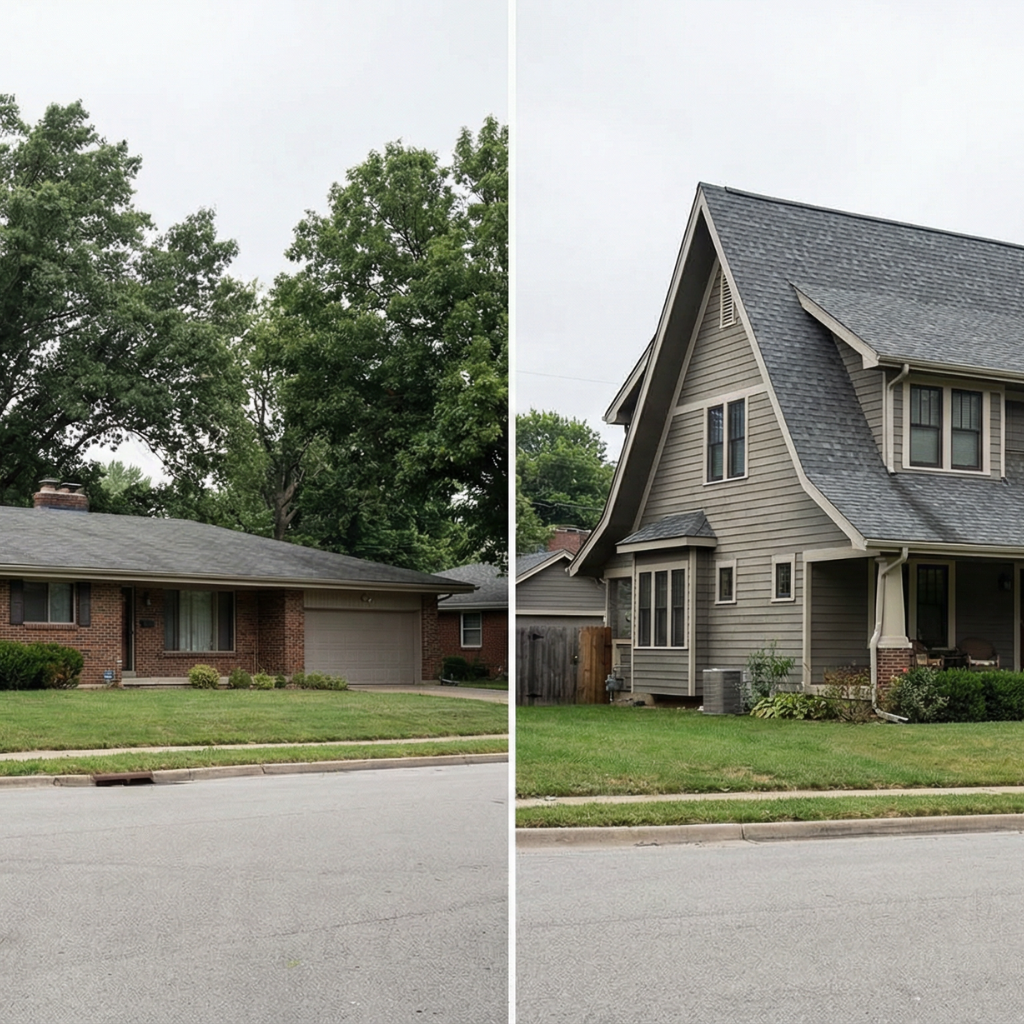
Your contractor handed you a quote. Somewhere on page one, it says “6/12 pitch.” You nodded like you understood. You did not. That number affects how much material your roof needs, how much labor costs, what shingles can be installed, and whether your home is a candidate for solar panels. This guide explains what roof pitch is, how to measure yours, and why it affects roof cost, your weather protection, and your next roofing decision.
TLDR: Roof pitch is the steepness of your roof, expressed as inches of rise per 12 inches of horizontal run. Most Missouri homes fall in the 4/12 to 6/12 range, which is the sweet spot for standard materials and standard cost. Steeper pitches add 15 to 30 percent to labor costs. Lower pitches require special materials. Understanding your pitch helps you read estimates, compare bids, and make informed decisions about your roof.
You are about to spend $10,000 or more on a roof replacement, and the single number that affects almost every line on that estimate is one most homeowners have never thought about. Pitch determines how much roofing material you need, what materials are code-compliant for your home, how fast water drains off your roof, and how much labor your contractor charges. It even affects your insurance rate and whether your roof is suitable for solar.
Here is what you need to know.
What Roof Pitch Is
Roof pitch is the steepness of your roof, expressed as a ratio of vertical rise to horizontal run. The run is always measured over 12 inches. A 4/12 pitch means the roof rises 4 inches for every 12 inches of horizontal distance. A 6/12 pitch rises 6 inches per foot. A 12/12 pitch rises a full 12 inches per foot, which is a 45-degree angle.
In everyday roofing, the terms “pitch” and “slope” mean the same thing. Contractors, manufacturers, and building codes all use them interchangeably.
Most residential homes in the United States fall between 4/12 and 9/12. The average roof pitch in North America is approximately 5/12. In Southwest Missouri, homes primarily fall in the 4/12 to 6/12 range, which is considered standard slope.
| Category | Pitch Range | What It Means |
|---|---|---|
| Flat or low-slope | 0/12 to 2/12 | Requires membrane roofing (TPO, EPDM); standard shingles cannot be used |
| Low-slope | 2/12 to 4/12 | Special underlayment required for shingles; common on porches and additions |
| Standard | 4/12 to 6/12 | Most Missouri homes; walkable, standard materials, standard labor cost |
| Moderately steep | 7/12 to 8/12 | Standard shingles work; labor cost increases; fall protection required |
| Steep | 9/12 and above | Excellent drainage, significantly higher labor cost, specialized equipment |
How to Measure Your Roof Pitch
You do not need to climb on your roof to find out your pitch. The safest method uses your attic.
From the Attic (Recommended)
The underside of your roof has the same pitch as the exterior surface. Place a 12-inch level horizontally along the underside of a rafter. Mark a point 12 inches along the level from where it touches the rafter. Measure straight down from that mark to the rafter. That vertical distance in inches is your rise. If you measure 6 inches, your pitch is 6/12.
From the Roof Surface
Place a level flat on the roof surface. Measure 12 inches along the level from the low end. Measure straight up from the roof surface to the 12-inch mark. That vertical distance is your rise. Never climb on a roof that is wet, icy, or steep without proper fall protection.
Smartphone Apps
Apps like Pitch Gauge use your phone’s accelerometer to measure slope. Hold the phone against a rafter in the attic or at the roof edge. Results are instant. Useful for quick estimates, but physical measurement with a level and tape measure is more accurate for contractor quoting.
Pro tip: Knowing your pitch before you request estimates helps you evaluate bids. If a contractor quotes a different pitch than you measured, ask them how they arrived at their number. A legitimate contractor measures pitch as part of their inspection.
Why Pitch Matters: The Six Things It Affects
1. Water and Snow Drainage
The steeper the pitch, the faster water and snow shed off your roof. Low-slope roofs drain slowly, which increases the time water sits on the surface. Any water that remains on a roof for more than 48 hours is classified as ponding water, which accelerates membrane aging and can cause structural problems.
Missouri’s combination of heavy spring thunderstorms, summer downpours, and winter freeze-thaw cycles makes drainage especially important. A minimum pitch of 2/12 is required by the International Residential Code for any shingle roofing assembly. Below that, standard shingles simply cannot be used.
Pro tip: If your home has a flat or low-slope section over a porch or addition, that area needs a completely different roofing system than the rest of your house. If it currently has standard shingles on a pitch below 4/12, it was installed incorrectly and should be evaluated.
2. What Materials Can Go on Your Roof
Not every material works on every pitch. The International Residential Code and professional roofing contractor guidelines set minimums.
| Material | Minimum Pitch Required |
|---|---|
| Standard asphalt shingles | 4/12 (2/12 with double underlayment per IRC R905.2.2) |
| Metal shingles or panels | 3/12 |
| Standing seam metal | 1/12 |
| Clay or concrete tile | 4/12 (flat tile); 2.5/12 (interlocking) |
| Wood shingles | 3/12 |
| TPO or EPDM membrane | 0.25/12 |
If your home has a 3/12 pitch and a contractor quotes standard shingles without mentioning special underlayment, that is a code violation. Ask specifically what underlayment is included on any low-slope section.
3. How Pitch Changes Your Replacement Cost
This is the concept most homeowners never learn until they see their quote. A sloped roof covers more surface area than the home’s flat footprint. Contractors calculate the actual roof area using a pitch multiplier.
| Pitch | Multiplier | Extra Area vs. Flat Footprint |
|---|---|---|
| 4/12 | 1.054 | +5.4% |
| 5/12 | 1.083 | +8.3% |
| 6/12 | 1.118 | +11.8% |
| 7/12 | 1.157 | +15.7% |
| 8/12 | 1.202 | +20.2% |
| 9/12 | 1.250 | +25.0% |
| 12/12 | 1.414 | +41.4% |
Real example: A Nixa homeowner replacing their roof had a 2,000-square-foot footprint and a 6/12 pitch, giving an actual roof area of 2,000 times 1.118, which equals 2,236 square feet of roofing to install. If that same home had a 9/12 pitch, the actual area would be 2,500 square feet. That is 264 more square feet of shingles, underlayment, and labor with no change to the home’s size.
Pro tip: When comparing estimates, check that the square footage listed reflects the actual roof area with the pitch multiplier applied, not just the home’s floor plan. Any estimate that shows the same square footage as your home’s footprint is incomplete. A detailed roofing cost guide for Springfield homeowners should always list the measured pitch and the calculated roof area.
4. Labor Costs Rise Sharply on Steep Roofs
Beyond materials, pitch directly drives labor costs. At 4/12 to 6/12, roofers can walk the roof freely with no specialized equipment. At 7/12 to 8/12, fall protection systems become required and labor time increases roughly 20 percent. At 9/12 and steeper, scaffolding, mechanical lifts, and specialized safety setups add significant overhead. Workers move 30 to 50 percent slower on steep roofs than on standard-pitch roofs.
Steep roofs (8/12 and above) add 15 to 30 percent to total labor costs on moderately steep pitches. At 9/12 and above, that premium can reach 20 to 50 percent. On a $15,000 standard-pitch job, a steep-pitch premium of $2,250 to $4,500 is realistic, bringing the total to $17,250 to $19,500.
Real example: A homeowner in Ozark needing a roof replacement on a steep 9/12 gable roof received three estimates that were all $3,000 to $4,000 higher than what their neighbor paid for a similar-sized home with a 5/12 pitch. The difference was entirely labor and additional material from the pitch multiplier. Neither contractor was overcharging. The roof simply required more time, more safety equipment, and more material.
Pro tip: If your quote seems high compared to a friend’s or neighbor’s, ask about the pitch. A 9/12 roof costs significantly more than a 5/12 roof on the same-sized home. Comparing total prices without accounting for pitch is not an apples-to-apples comparison.
5. Ice Dams, Ventilation, and Attic Space
Ice dams form when heat escaping through the attic warms the roof surface, melts snow, and the water refreezes at the colder eaves. Missouri’s frequent freeze-thaw cycles make this a real seasonal risk. Low-pitched roofs are more susceptible because water moves slowly across flat surfaces, giving it more time to refreeze before reaching the gutters.
The fix for ice dams is not about pitch. It is about proper air sealing, insulation, and ventilation. The University of Missouri Extension confirms that ice dams on Missouri roofs form because of nonuniform roof temperatures caused by heat leaking into unheated attics. But pitch affects how quickly water reaches gutters before it refreezes. For a deeper look at prevention techniques, see Roov’s guide to preventing ice dams on your Missouri roof.
Steeper roofs also create more natural airflow in the attic, helping regulate temperature and moisture. This is one reason steep-pitch roofs tend to extend material life. Materials dry faster after rain and accumulate less moss, debris, and biological growth.
6. Insurance, Wind Resistance, and Home Value
Roof shape and pitch both influence homeowner insurance rates. Hip roofs (four-sided) typically receive the most favorable treatment because of their superior wind resistance. Gable roofs (the triangular two-sided shape most common in Missouri) are more vulnerable to wind uplift at the gable ends.
Research on wind performance shows that moderate pitches around 7/12 (approximately 30 degrees) allow wind to flow smoothly over the roof, reducing uplift stress. Flat and very steep roofs both perform less favorably in high wind events for different reasons.
A new roof can reduce homeowner insurance premiums by 5 to 35 percent, with the national average discount around 20 percent. Impact-resistant materials amplify this discount. If your roof has storm damage, Roov walks you through the entire insurance claims process from inspection to settlement.
A roof replacement adds an average of $17,807 in resale value according to the 2023 Remodeling Magazine Cost vs. Value report. A steep, architecturally prominent pitch increases curb appeal and perceived quality, but only if the materials match the home’s style and condition.
Pitch and Solar Panels: The Missouri Angle
This is a section most roofing blogs skip, but it is increasingly relevant for Missouri homeowners considering solar.
Missouri sits at approximately 37 to 40 degrees north latitude. For Springfield (about 37.2 degrees north), the optimal solar panel tilt is approximately 34 to 35 degrees, which corresponds to a 7/12 to 8/12 pitch. The DOE’s guide to planning a home solar electric system explains how roof orientation and tilt affect energy production.
Most Southwest Missouri homes fall in the 4/12 to 6/12 range, which produces 85 to 100 percent of maximum possible solar output when the roof faces south. The key factor is orientation (south-facing is optimal), not pitch alone. A north-facing roof of any pitch produces roughly 30 percent less energy than a south-facing equivalent.
Pro tip: If you are replacing your roof and considering solar in the future, mention it during your estimate. Your contractor can ensure the new roof is solar-ready with proper mounting points and appropriate materials. Installing solar on a brand-new roof avoids the cost of removing and reinstalling panels later.
Pitch and Your Estimate: What to Watch For
When reviewing a roofing estimate, look for the pitch listed explicitly. A legitimate estimate always includes the measured pitch, such as “6/12 main field, 4/12 porch addition.” The square footage should reflect actual roof area with the pitch multiplier applied, not just the footprint. Any pitch above 7/12 or 8/12 should carry a noted labor surcharge. And the material specs should match the pitch. If a home has a 3/12 section and the estimate only shows standard underlayment, push back.
Real example: A homeowner getting a roof estimate in Bolivar received a quote that listed 1,800 square feet of roofing on a home with a 1,600-square-foot footprint and a 6/12 pitch. The correct number with the 1.118 multiplier should have been about 1,789 square feet, which was close. But the estimate did not separately address a 200-square-foot flat porch section that needed membrane roofing instead of shingles. The contractor had planned to shingle the entire roof, including the flat section. Roov’s inspection caught the discrepancy before work began.
Pro tip: If an estimate does not list the pitch or shows the same square footage as your home’s floor plan, it is incomplete. Ask your contractor to show you the measured pitch and the multiplier they used. A transparent contractor will have this information ready.
Frequently Asked Questions
Q: What is the most common roof pitch in Missouri?
Most residential homes in Southwest Missouri fall in the 4/12 to 6/12 range. This is considered standard slope. It is walkable for roofers, compatible with all standard asphalt shingle products, and does not carry a steep-pitch labor premium.
Q: What does 6/12 roof pitch mean?
A 6/12 pitch means the roof rises 6 inches for every 12 inches of horizontal distance. It is one of the most common pitches in Southwest Missouri. It is walkable for roofers, compatible with all standard asphalt shingle products, and priced at standard labor rates. The pitch multiplier for 6/12 is 1.118, meaning your actual roof area is 11.8 percent larger than your home’s footprint.
Q: Can I put regular shingles on a low-slope roof?
Standard asphalt shingles require a minimum pitch of 4/12 under the International Residential Code. At 2/12 to 4/12, shingles can be used but require double underlayment as specified in IRC R905.2.2. Below 2/12, you need a membrane system like TPO or EPDM. If your low-slope section currently has standard shingles without proper underlayment, it was not installed to code.
Q: Does a steeper roof cost more to replace?
Yes. A steeper roof has more surface area per square foot of home footprint, requires more material, and takes longer to install because crews work slower and need additional safety equipment. A 9/12 pitch adds roughly 25 percent more roof area and 15 to 30 percent more labor cost compared to a standard 5/12 pitch.
Q: How does pitch affect ice dams?
Low-pitched roofs are more susceptible to ice dams because water moves slowly across the surface, giving it more time to refreeze at the eaves. The underlying cause of ice dams is heat escaping through the attic, not the pitch itself. Proper insulation, air sealing, and ventilation are the real solutions.
Q: Does my roof pitch affect solar panel efficiency?
For Southwest Missouri (approximately 37 degrees north latitude), the optimal solar tilt is 34 to 35 degrees, which corresponds to about a 7/12 to 8/12 pitch. But a south-facing roof at 4/12 to 6/12 still produces 85 to 100 percent of maximum possible output. Roof orientation (south vs. north) matters more than pitch.
Q: How do I find out my roof’s pitch?
The safest method is from the attic. Place a 12-inch level along the underside of a rafter, measure 12 inches along the level, then measure straight down from that point to the rafter. That vertical distance in inches is your rise. Alternatively, a Roov inspector will measure and document your pitch as part of every free Roof Condition Report.
Q: Should pitch be listed on my roofing estimate?
Yes. Any professional estimate should list the measured pitch and calculate the actual roof area using the appropriate multiplier. If the estimate does not include pitch or the square footage matches your home’s floor plan exactly, it is likely incomplete.
Q: Does roof pitch affect my insurance rate?
Pitch is one of many factors in insurance underwriting. Shape matters more. Hip roofs (four-sided) typically receive the best rates because of superior wind resistance. Materials, age, and certification status also affect premiums. A new roof with impact-resistant shingles can reduce premiums by 5 to 35 percent regardless of pitch.
Key Takeaways
Pitch determines your replacement cost. A 6/12 roof has 11.8 percent more surface area than the home’s footprint. A 9/12 roof has 25 percent more. That difference shows up on every line of your estimate.
Most Missouri homes are in the sweet spot. The 4/12 to 6/12 range is standard for materials, labor, and cost. You get reliable drainage, full material compatibility, and no steep-pitch premium.
Steep roofs cost more to replace. Pitches of 8/12 and above add 15 to 30 percent to labor costs due to slower work, additional safety equipment, and more material. Know your pitch before you compare quotes.
Low-slope sections need different materials. Any section below 4/12 requires special underlayment or membrane roofing. If your porch, addition, or garage has standard shingles on a low pitch, it may not be code-compliant.
Your pitch is on every good estimate. A transparent contractor lists the measured pitch, applies the correct multiplier, and explains how it affects your cost. If your estimate does not include pitch, ask.
A free inspection tells you everything. Roov’s Roof Condition Report includes pitch measurement, material assessment, and a clear explanation of what your pitch means for your next roofing decision.
Ready to Find Out What Your Pitch Means for Your Roof?
You now understand how pitch affects everything from material choice to cost to solar potential. The next step is finding out your specific pitch and what it means for your home.
Roov is Southwest Missouri’s trusted roofing partner. We bring “Roofing with a Purpose” to every job. That means honest answers, quality materials, and a team that treats your home like our own. We are GAF Master Elite certified, CertainTeed ShingleMaster certified, and Owens Corning Preferred Contractor.
Here is what we offer:
- Free, no-pressure Roof Condition Reports with pitch measurement included
- Detailed estimates that show measured pitch, multiplier, and actual roof area
- Expert assistance with insurance claims for storm-damaged roofs
- Local crews who live and work in your community
Ready to get started? Contact us today:
Call: 417-370-1259
Email: [email protected]
We serve Nixa, Ozark, Bolivar, and all surrounding Southwest Missouri communities. Schedule your free roof inspection today. Let’s measure your pitch and show you exactly what it means for your roof.
Roov | Roofing with a Purpose | Serving Southwest Missouri