
Most homeowners in Southwest Missouri think about their roof when something goes wrong. But they rarely think about gutters until water is pouring over the edge. The truth is, your gutters and your roof are part of the same system. When gutters fail, your roof pays the price, and so does your wallet.
This guide explains exactly how gutters affect your roof’s health, what happens when they’re neglected, and what you can do right now to protect your home. Whether you have a simple clog or an aging gutter system that needs replacing, you’ll finish this article knowing exactly what to do next.
TLDR: Gutters are your roof’s drainage system. When they clog, sag, or fail, water backs up and damages your shingles, fascia, soffit, and foundation. Cleaning gutters at least twice a year is the single best thing you can do to extend your roof’s life. Read on for a full breakdown of gutter types, warning signs, and when to call Roov.
Your roof sheds thousands of gallons of rainwater every year. That water has to go somewhere. Well-functioning gutters collect it, channel it to downspouts, and direct it safely away from your home’s foundation and landscaping. When something goes wrong with that system, the consequences ripple outward in every direction.
In Southwest Missouri, the problem is especially real. Between our spring thunderstorms, summer downpours, fall leaf seasons, and freeze-thaw winter cycles, our gutters work harder than almost anywhere else in the country. Understanding what they do and what happens when they fail is the first step to protecting your home.
Why Gutters Are Your Roof’s First Line of Defense
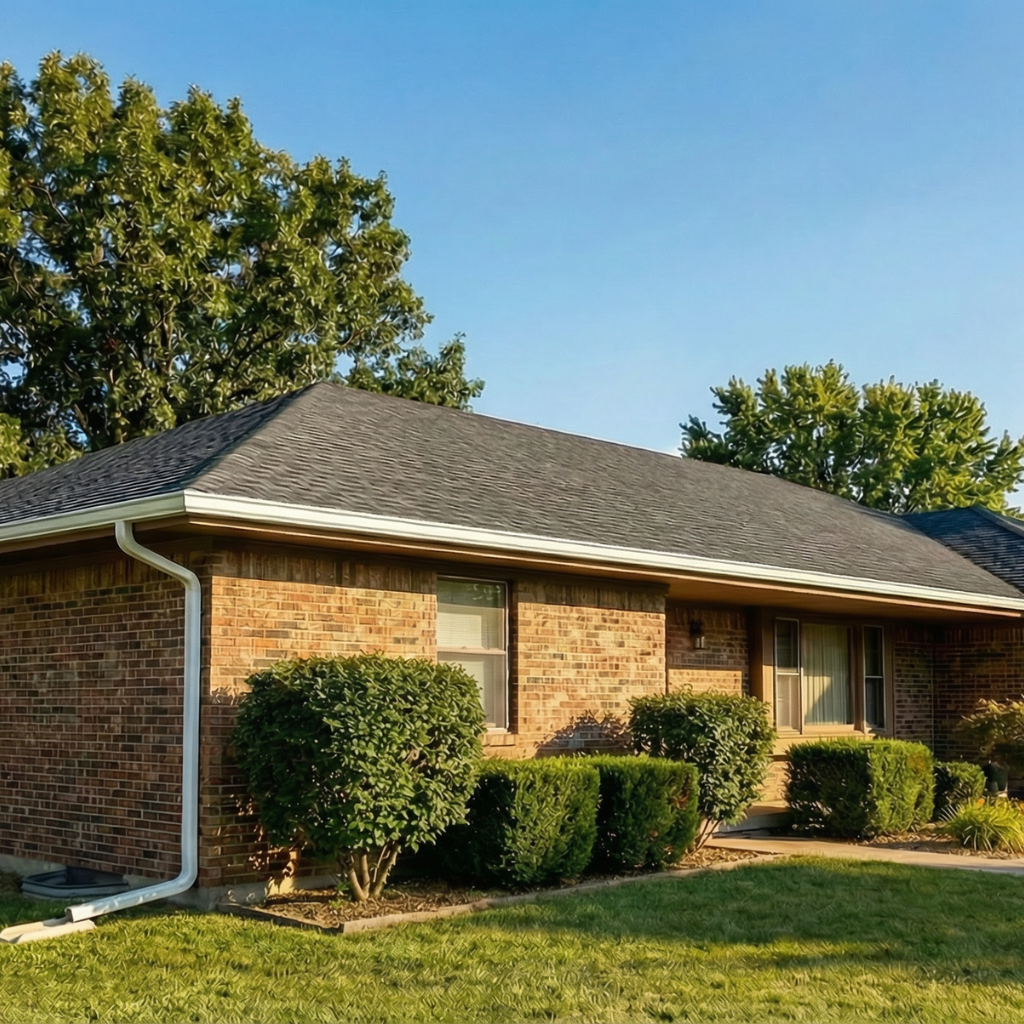
Gutters are not just trim on the outside of your home. They are an active, functional part of your roof system. Every inch of rain that falls on your roof is collected by the gutter trough, directed along the gutter run toward a downspout, and discharged away from your foundation.
When that process is interrupted, water has nowhere to go. It overflows, pools, seeps, and sits. That sitting water is the enemy of everything from your shingles to your attic to your basement floor.
Three things every gutter system must do to protect your roof:
- Collect runoff from the entire roof surface without overflow
- Direct water to downspouts through a proper slope (1/4 inch per 10 feet of gutter)
- Discharge water at least 6 to 10 feet away from the foundation
When any one of those three functions breaks down, the result is damage to your home. The Insurance Institute for Business & Home Safety (IBHS) identifies proper water management as one of the most critical factors in preventing residential property damage.
What Happens When Gutters Fail
Water Overflow and Shingle Damage
The most immediate consequence of a clogged gutter is water overflow. When debris blocks the trough, rainwater spills over the edge and pools along the roofline. That standing water seeps under shingles, saturates the wood decking underneath, and works its way into your attic before you ever see a ceiling stain. Over time, the decking rots, the shingles warp, and what started as a clogged gutter becomes a full roof replacement.
Real example: A homeowner in Strafford notices water stains on the living room ceiling after a heavy storm. A roof inspection shows no cracked shingles. The real culprit? A gutter packed solid with leaves from the oak trees in the backyard. Water has been overflowing at the same spot for months, soaking the same section of decking on every rainy day. The decking requires replacement before a new roof can be installed.
Fascia and Soffit Rot
The fascia (the horizontal board that runs along the roofline and holds the gutters) is especially vulnerable to gutter failure. When gutters overflow or pull away from the home, water runs directly down behind the gutter and soaks the fascia and soffit (the underside of the roof overhang) continuously. Wood fascia and soffit rot quietly for months or years before you notice sagging, peeling paint, or visible discoloration.
Repairing water damage to fascia and soffit costs $9 to $34 per linear foot, and full replacement runs $900 to $6,800 or more depending on the extent of the damage. That’s a steep price for a repair that is almost entirely preventable with clean, properly hung gutters.
Tip: Walk the perimeter of your home after a heavy rain. If you see water running behind the gutter or dripping between the gutter and fascia board, your gutters are either clogged, improperly sloped, or pulling away from the home. Call Roov for a free inspection before the rot sets in.
Ice Dams in Missouri Winters
Missouri winters are unpredictable. Temperatures swing above and below freezing regularly, which creates the perfect conditions for ice dams. An ice dam forms when snow on your roof melts from the warmer upper sections and refreezes when it reaches the cold overhang at the roof’s edge. Clogged gutters accelerate this process dramatically: water that can’t drain freezes in the gutter trough and backs up under the shingles.
According to the University of Missouri Extension, ice dam water forced under shingles can lead to dislodged shingles, sagging gutters, damaged insulation, corroded metal fasteners, and mold growth in attics and walls. These are not cosmetic issues. They are structural ones.
Real example: A family in Forsyth experiences interior water stains every February. An inspection reveals that oak tree leaves fill the gutters every fall and are never fully cleared before winter. The trapped moisture freezes into a solid block each December, forcing meltwater back under the first two courses of shingles. The fix is not just a new roof. It’s clean gutters every November before the first hard freeze.
Foundation and Basement Damage
When gutters overflow and downspouts discharge water too close to the home, the soil around your foundation becomes saturated. Over time, hydrostatic pressure fractures basement walls, triggers foundation settlement, and allows water to seep into crawl spaces and basements. A downspout that discharges within 6 feet of the foundation is a slow-motion threat to your home’s structural integrity.
Tip: Extend every downspout at least 6 feet from the foundation using a downspout extension or a splash block that directs water toward the yard. In particularly flat lots, buried extensions running 20+ feet from the home provide the best protection.
Pest Infestations
Standing water in gutters is a magnet for mosquitoes, which can breed in as little as a bottle cap of standing water. But the problem does not stop there. Soggy, debris-filled gutters also attract birds, rodents, and wasps looking for nesting sites. Once pests establish themselves in your gutters and the adjacent fascia or soffit, extermination and structural repair can cost $125 to $2,000 on top of the gutter work itself.
Signs Your Gutters Are Hurting Your Roof
You do not need to climb a ladder to spot most gutter problems. Walk around your home and look for these warning signs:
| Warning Sign | What It Means |
|---|---|
| Water spilling over gutter edges during rain | Clog or improper slope |
| Sagging or pulling-away gutters | Weight from debris and water; loose hangers |
| Peeling paint on fascia or siding near roofline | Chronic moisture from overflow |
| Rust stains or discoloration on gutters | Age and standing water damage |
| Mold or mildew on siding or soffit | Water not draining properly |
| Soil erosion directly below gutter edges | Water overflowing and channeling at one spot |
| Plant growth inside gutters | Long-standing debris and moisture |
| Interior water stains on ceilings or walls | Water forced under shingles from gutter backup |
Any one of these signs is reason to have your gutters and roof inspected at the same time. Gutters and roofs fail together, and the damage usually shows up on the roof first.
Gutter Materials: Which Is Right for Your Southwest Missouri Home?
Not all gutters are the same, and the climate in Southwest Missouri demands materials that can handle wide temperature swings, heavy rain, and occasional hail. Here is how the most common options compare:
| Material | Cost Installed | Lifespan | Best For | Caution |
|---|---|---|---|---|
| Aluminum (seamless) | $5-$12/ft | 20-30 years | Most Southwest Missouri homes | Can dent from hail or ladder impact |
| Steel (galvanized) | $8-$15/ft | 20-25 years | High storm exposure areas | May rust over time without coating |
| Copper | $15-$40/ft | 50-100 years | Historic or luxury homes | High upfront cost |
| Vinyl (PVC) | $3-$6/ft | 10-15 years | Budget-friendly; mild climates | Cracks in freeze-thaw cycles; not recommended for MO |
| Stainless Steel | $15-$30/ft | 50+ years | Commercial, severe weather | Higher cost, harder to source |
The right choice for most Southwest Missouri homes is seamless aluminum. It resists rust, handles our humidity, comes in dozens of colors, and can be installed as one continuous piece with no seams to leak. Copper is a premium option for historic or upscale homes that want a natural patina finish that lasts a century. The National Roofing Contractors Association (NRCA) provides additional guidance on material selection and drainage system standards.
Roov installs seamless gutter systems with properly positioned downspouts and gutter screens to keep debris out.
Real example: A homeowner in Ozark replaces their original vinyl gutters installed in the early 2000s. After two Missouri winters, the vinyl cracked at the corners and along seam joints, allowing water to drip behind the fascia. Switching to seamless aluminum gutters and adding gutter guards eliminates the problem permanently.
Gutter Styles: K-Style vs. Half-Round
Beyond material, gutter style affects performance, appearance, and cost.
| Style | Shape | Capacity | Best For |
|---|---|---|---|
| K-Style | Flat back, decorative front profile | Higher water volume | Modern homes; most common in Missouri |
| Half-Round | Semicircular trough | Moderate water volume | Historic, brick, and traditional homes |
K-style gutters are the standard for most homes in Southwest Missouri because they hold more water volume and attach directly to fascia boards without additional hardware. Half-round gutters give older homes a more period-appropriate look and are often required in historic districts.
Gutter Guards: Are They Worth It?
Gutter guards reduce how often you need to clean gutters, but they do not eliminate maintenance entirely. Understanding the types helps you choose the right protection for your home and the trees around it.
| Type | How It Works | Best For | Limitation |
|---|---|---|---|
| Micro-mesh | Fine stainless mesh blocks all debris | Homes with pine trees or small seeds | Higher cost; requires professional install |
| Reverse curve (hood) | Water curves into gutter; debris falls off | Homes with large leaf debris | Ineffective for pine needles and small seeds |
| Screen/perforated | Flat panel blocks large debris | Average debris levels | Smaller particles still enter |
| Foam insert | Porous foam allows water through | Low-debris areas only | Traps debris in foam; mold risk |
| Brush insert | Cylindrical brush catches debris | Simple, DIY-friendly | Debris tangles in brush; frequent cleaning still needed |
Pro tip: In Southwest Missouri, where oak catkins, maple seeds, and pine needles are common, micro-mesh guards offer the best long-term protection. Foam and brush guards are not recommended for our climate because they trap debris and promote mold growth.
Gutter guards cost $5 to $45 per linear foot installed, with premium systems reaching $150+ per linear foot. The upfront cost is real, but so is the savings on cleaning labor and the prevention of costly water damage.
How Often Should Missouri Homeowners Clean Their Gutters?
The general industry recommendation is twice a year: once in spring and once in fall. In Missouri, that minimum may not be enough depending on your property.
Missouri’s hardwood trees (silver maple, white oak, and sweet gum among others) drop leaves in fall and seeds and catkins in spring. Combined with our frequent heavy rainstorms and freeze-thaw winter cycles, gutters in Missouri take more abuse than the national average.
Missouri homeowners should clean gutters:
- Spring after tree seeds and catkins fall, and before heavy thunderstorm season begins
- Late fall after the majority of leaves have dropped, but before the first hard freeze
- After major storms when hail, high winds, and heavy rain deposit debris quickly
- Homes with overhanging trees every 3 to 4 months
Real example: A homeowner in Lebanon has two large silver maple trees overhanging the roofline. She cleans gutters twice a year but still notices water marks on the fascia each summer. Once she moves to quarterly cleanings and adds micro-mesh gutter guards, the problem disappears entirely.
Tip: The best time for fall cleaning is after the majority of leaves have fallen but before the first major winter storm. Cleaning too early means the gutters fill again before winter. Cleaning too late means the first freeze traps leaves in place.
Gutter Slope: The Detail Most Homeowners Miss
Gutters must be installed at a slight downward angle so water flows toward the downspout instead of pooling in the trough. The industry standard is a slope of 1/4 inch for every 10 feet of gutter run. On a 40-foot gutter run with a downspout at one end, the far end should sit 1 inch higher than the downspout end.
When gutters are too flat or slope the wrong direction, water pools instead of flowing. That standing water adds weight, accelerates corrosion, creates ice dam risk in winter, and breeds mosquitoes in summer.
One downspout is recommended for every 30 to 40 feet of gutter run. Longer runs need two downspouts with the gutter sloping toward the center from both ends, or sloping toward opposite ends.
Pro tip: If you hear gurgling or splashing from your gutters during rain, or notice water pooling in the middle of a gutter run, the slope may be off. This is a common result of gutters pulling away from the fascia over time as fasteners work loose. Roov checks gutter slope and condition as part of every free roof inspection.
When to Repair vs. Replace Your Gutters
Not every gutter problem requires a full replacement. Here is how to think about the decision:
Repair is usually the right call when:
- Damage is localized to one or two sections
- A single joint or seam is leaking (seal with gutter caulk)
- A few hangers are loose or bent (screw in new hangers)
- Minor cracks are present (seal with waterproof sealant or metal flashing)
Replace when:
- Gutters are sagging across multiple sections
- Widespread rust, peeling paint, or visible holes are present
- The gutters are pulling away from the fascia along the full run
- Fascia or soffit damage has already occurred from long-term gutter failure
- Gutters are more than 20 years old with recurring problems
Real example: A homeowner in Highlandville notices a single section of gutter sagging near a corner. The hanger has simply worked loose. A Roov inspection catches this during a routine roof check, and the gutter is re-secured and re-sloped the same day for a fraction of the cost of replacement. Catching it early is everything.
Tip: When replacing your roof, always evaluate your gutters at the same time. Pairing old gutters with a new roof is like putting worn tires on a new car. The gutters set the drainage for the entire roof system.
Southwest Missouri: Why Gutters Work Harder Here
Southwest Missouri homeowners face a unique combination of challenges:
- Spring brings heavy thunderstorm rain events that can overwhelm gutters in minutes
- Summer adds humidity, mosquito risk from standing water, and hailstorms that dent aluminum gutters
- Fall drops a heavy load of leaves and seeds from oak, maple, and sweet gum trees throughout the Ozarks
- Winter brings freeze-thaw cycles that crack vinyl gutters, work loose aluminum hangers, and set the stage for ice dams
For homeowners in Springfield, Nixa, Bolivar, Branson, Kimberling City, and the surrounding communities, a gutter maintenance plan is not optional. It is a core part of protecting a home in this climate.
Real example: A homeowner in Seymour calls Roov in March after noticing interior water stains that appeared over the winter. An inspection shows that debris-packed gutters caused ice dams in December and January. Water forced under the shingles at the eave repeatedly over three freeze-thaw cycles. Two courses of shingles, a section of decking, and the fascia board all need to be replaced. The entire situation began with a gutter that was never cleaned in the fall.
“Good gutters protect your foundation and landscaping from water damage. We install seamless gutter systems, properly positioned downspouts, and gutter screens to keep debris out.” — Roov
FAQ: Gutters & Roof Health in Southwest Missouri
Q: Can clogged gutters really cause a roof leak? A: Yes, directly. When gutters overflow, water pools along the roofline and seeps under the bottom courses of shingles. From there it soaks the decking, gets into the attic, and eventually shows up as a stain on your ceiling. Many homeowners never connect the gutter problem to the roof leak. Always inspect gutters when investigating a leak.
Q: How do I know if my gutters are the right size? A: Standard 5-inch K-style gutters handle most homes in Southwest Missouri. Larger homes or homes with steep roof pitches may need 6-inch gutters to handle peak water volume. If your gutters overflow during heavy rain even when they are clean, the system is undersized. Roov can evaluate your gutter capacity during a free inspection.
Q: Does homeowners insurance cover gutter damage? A: It depends on the cause. Storm damage to gutters from hail, falling branches, or high winds is typically covered under a standard homeowners policy. Damage caused by neglect (clogged and rotten gutters) is generally not covered. Roov’s insurance claim experts can review your situation and help you understand what your policy covers.
Q: Should I install gutter guards or just clean more often? A: Both are valid. For homes with heavy tree coverage in areas like Ava, Aurora, or wooded lots throughout Greene County, micro-mesh gutter guards offer genuine long-term value. For homes with minimal tree exposure, a consistent twice-a-year cleaning schedule may be sufficient. Roov can help you evaluate whether guards make sense for your specific property.
Q: How much do new gutters cost in Southwest Missouri? A: Most homeowners spend $2,000 to $6,000 on a full gutter replacement, or roughly $4 to $40 per linear foot depending on material. Seamless aluminum (the most popular choice in this region) runs $5 to $12 per linear foot installed. Adding gutter guards ranges from $5 to $45 per linear foot.
Q: My gutters look fine from the ground. Do they really need cleaning? A: Yes. Gutters can appear functional while clogged with compacted debris, standing water, or mold you cannot see from the ground. The safest approach is a professional inspection twice a year. Roov includes gutter condition in every roof inspection at no additional cost.
Key Takeaways
- Gutters are part of the roof system. When they fail, the roof, fascia, soffit, and foundation all suffer.
- Clogged gutters are the #1 preventable cause of roof water damage. Water overflow under shingles leads to decking rot and interior leaks.
- Missouri winters make clean gutters essential. Clogged gutters accelerate ice dam formation, which forces water under shingles and into attics.
- Clean gutters at least twice a year. Spring and fall are the minimum; quarterly cleaning is better for wooded properties in Southwest Missouri.
- Seamless aluminum is the best material for most Missouri homes. Avoid vinyl in freeze-thaw climates.
- Proper slope matters. Gutters must pitch 1/4 inch per 10 feet toward the downspout or water pools instead of drains.
- Downspouts need distance. Discharge water at least 6 to 10 feet from the foundation.
- Repair vs. replace. Localized damage can be repaired cheaply; widespread sagging, rust, or rotted fascia calls for full replacement.
Ready to Protect Your Roof and Gutters?
You now know that your gutters are not just trim. They are the drainage system your roof depends on. And in Southwest Missouri’s storms, ice, and leaf seasons, a well-maintained gutter system is one of the most cost-effective investments you can make in your home.
Roov has helped hundreds of Southwest Missouri homeowners protect their homes from the ground up. “Roofing with a Purpose” means we look at your whole home, not just the shingles. When we inspect your roof, we evaluate your gutters too.
Here’s what we offer:
- Free, no-pressure Roof Condition Reports that include gutter evaluation
- Seamless gutter installation with properly positioned downspouts and gutter screens
- GAF Master Elite, CertainTeed Shingle Master, and Owens Corning Preferred certification
- Expert insurance claim assistance for storm-damaged gutters and roofs
- Gutter and downspout installation throughout Southwest Missouri
Ready to get started?
Call or text: 417-370-1259 Email: [email protected]
We serve Nixa, Springfield, Ozark, Branson, Bolivar, Marshfield, Lebanon, Aurora, Seymour, Highlandville, Kimberling City, and all surrounding communities across Southwest Missouri. Schedule your free inspection today. Let’s make sure your gutters are protecting your roof the way they should.
Roov | Roofing with a Purpose | Serving Southwest Missouri