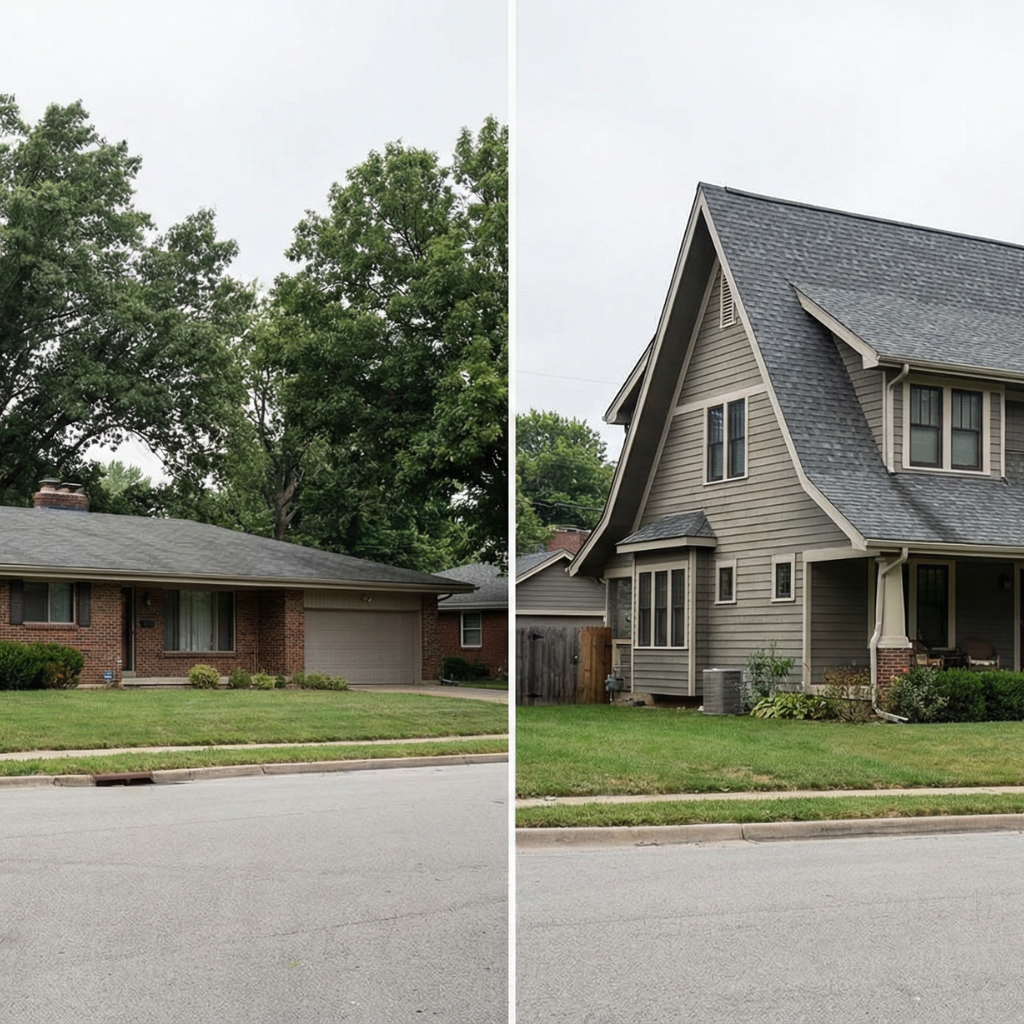

Most homeowners in Southwest Missouri never think about what’s under their shingles. You see the shingles, you see the gutters, and that’s about it. But underneath those visible layers are two critical components that determine whether your roof lasts 5 years or 30: the decking and the underlayment.
This guide explains both layers in plain language. You’ll learn what they are, why they matter, what Missouri building codes require, and how to spot the warning signs that something has gone wrong. Whether you’re getting estimates for a roof replacement or dealing with storm damage, understanding these hidden layers gives you a real advantage.
TLDR: Roof decking is the solid wood layer (plywood or OSB) that gives your roof its structure. Underlayment is the water-resistant barrier installed over the decking, under your shingles. If either layer fails, your shingles won’t save you. Missouri code requires specific underlayment based on roof slope and ice dam risk. Read on to learn what’s under your roof and why it matters.
Every roof you see from the street is really a system of layers working together. The shingles get all the attention, but they’re only the outermost shield. Strip them away and you’ll find the underlayment, a thin but critical moisture barrier. Below that sits the decking, the solid structural layer that holds everything up.
When either of these hidden layers fails, the damage happens from the inside out. Water reaches places it should never touch. Wood rots silently. Mold grows in your attic. And by the time you notice a ceiling stain or a sagging roofline, the repair bill has multiplied. Understanding these two layers is one of the smartest things a homeowner can do.
What Is Roof Decking?
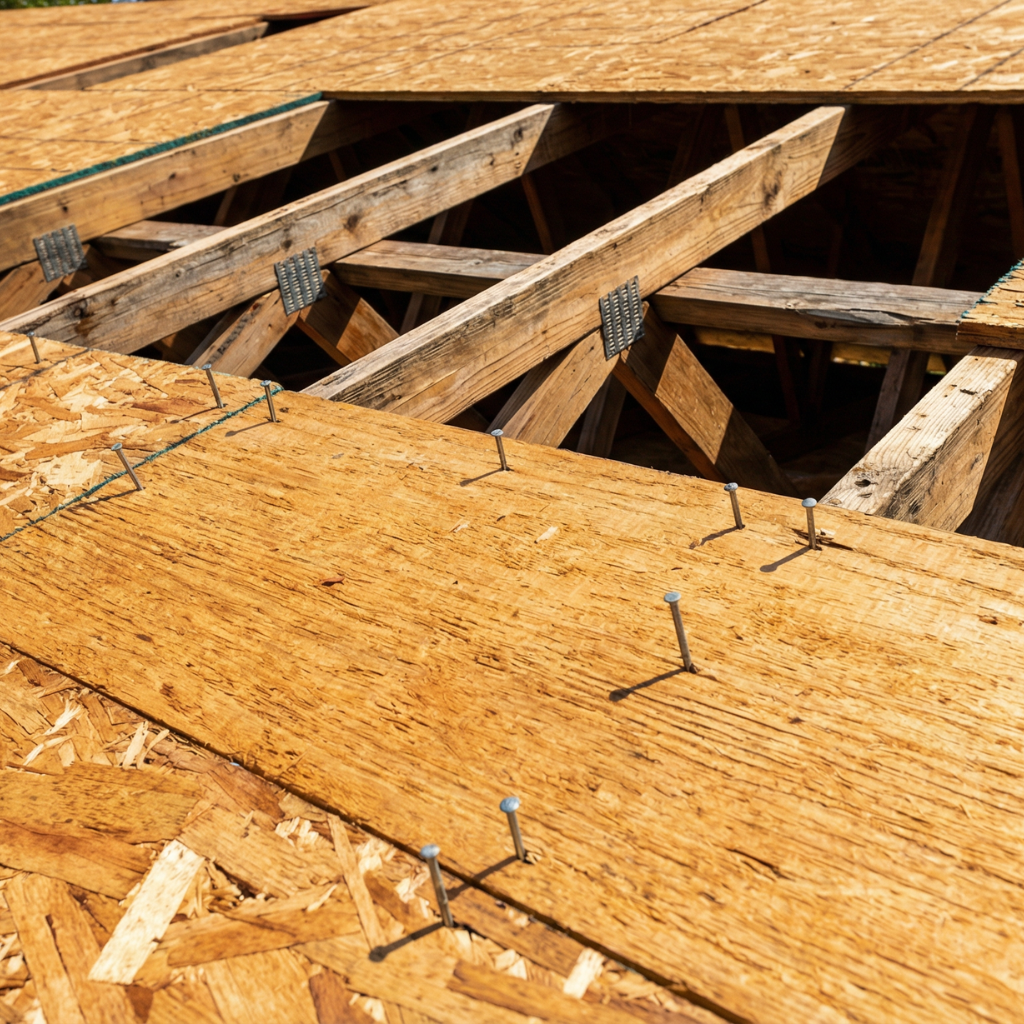
Roof decking (also called sheathing) is the solid wood layer nailed directly to your home’s rafters or trusses. It is the structural foundation of your entire roof system. Every other roofing component, from underlayment to shingles to flashing, is installed on top of the decking. If the decking is compromised, nothing above it performs correctly.
Today’s homes use one of two materials for decking: plywood or OSB (oriented strand board). Both work, but they handle moisture differently, and that matters in Missouri’s climate.
| Feature | Plywood | OSB |
|---|---|---|
| Cost | Higher | Lower (about 20-30% cheaper) |
| Weight (4×8 sheet) | ~67 lbs | ~78 lbs |
| Moisture performance | Dries faster; better long-term | Swells at edges; slow to dry |
| Nail holding strength | Very good | Good |
| Common thickness | 1/2″ to 3/4″ | 7/16″ to 5/8″ |
| Popularity | Second choice | First choice (cost advantage) |
OSB is the more common choice today because of cost. But in Southwest Missouri, where humidity is high and attic condensation is a real concern, plywood’s faster drying time can be a meaningful advantage. When OSB gets wet repeatedly and dries slowly, the edges swell. That swelling shows up on the surface as wavy or buckled shingles.
Skip Sheathing on Older Missouri Homes
If your home was built before 1960, there’s a good chance it has skip sheathing instead of solid decking. Skip sheathing is a system of individual boards with 4 to 6 inch gaps between them. It was designed for cedar shake roofs, which needed airflow underneath to prevent rot.
The problem? Skip sheathing cannot support modern asphalt shingles. The gaps mean there’s no solid surface for shingles to lay flat against. Any contractor who installs asphalt shingles directly over skip sheathing is setting the roof up for failure. The correct approach is to re-sheet the entire roof with solid OSB or plywood over the existing boards before installing any modern roofing material.
Real example: A homeowner in Battlefield is getting estimates for a full roof replacement. The first contractor quotes a standard re-roof. The second contractor (Roov) climbs into the attic and discovers original skip sheathing from the 1940s that a previous contractor shingled over without adding solid decking. The roof has been failing slowly for years. Roov re-sheets the entire deck with 7/16″ OSB before installing the new shingle system, which is the only way to do it right.
Missouri Code Requirements for Decking
Missouri follows the 2018 International Residential Code (IRC). Per IRC Section R803 / Table R803.1, the minimum decking thickness depends on your rafter spacing:
| Rafter Spacing | Minimum OSB Thickness | Minimum Plywood Thickness |
|---|---|---|
| 16″ on center | 7/16″ | 3/8″-15/32″ |
| 24″ on center | 7/16″ (with panel clips) | 15/32″ (~1/2″) |
In Southwest Missouri, where wind loads are higher due to tornado risk, 1/2″ is considered the practical minimum regardless of spacing. Always confirm with your contractor that the decking meets or exceeds local code before new shingles go on.
Signs Your Decking Is Failing
Decking damage is hard to spot because it’s hidden under your shingles. But there are warning signs you can look for without ever climbing on the roof:
| Warning Sign | What It Means |
|---|---|
| Sagging visible from the ground or in the attic | Structural weakness from rot or moisture damage |
| Shingles that appear wavy or buckled | OSB edge swelling from repeated moisture exposure |
| Water stains or black discoloration in the attic | Active or past water penetration reaching the wood |
| Soft or spongy feel underfoot when walking on the roof | Rot has weakened the wood structure |
| Cracking, crumbling, or musty odor in the attic | Advanced decay requiring immediate attention |
Tip: You can check your decking from inside the attic. Use a flashlight and look for dark spots, soft areas, or any place where daylight is visible through the roof boards. If you see any of these signs, schedule a professional inspection before the damage spreads.
Real example: A homeowner in Clever notices a musty smell in the upstairs bedrooms every spring. An attic inspection reveals that the original roof was installed with #15 felt underlayment and no ice and water shield at the eaves. Over three winters, ice dams forced water under the shingles and into the OSB decking. The decking is now black with rot along the entire north-facing eave. Four sheets of OSB must be replaced before a new roof can be installed.
The Three Types of Roof Underlayment
Underlayment is the water-resistant barrier installed directly over the decking, under your shingles. Think of it as your roof’s second line of defense. When shingles are damaged, missing, or when wind-driven rain finds a gap, the underlayment is what stands between that water and your decking.
There are three types, and each serves a different purpose.
Felt Underlayment (Asphalt-Saturated)
Felt underlayment is the traditional option. It’s made from fiberglass or organic mat saturated with asphalt. It comes in two weights: #15 (thinner, lighter) and #30 (twice as thick, more durable).
Felt is the most affordable underlayment at $15 to $40 per square depending on weight. The tradeoff is durability. Felt tears more easily during installation, absorbs moisture, and degrades when exposed to UV light. Felt that gets wet and is then exposed to sun can start losing its effectiveness within weeks. It should be covered with shingles as soon as possible, and never left exposed through a rain event if avoidable.
Tip: If your contractor uses felt, confirm it will be covered with shingles the same day it’s installed. Felt left exposed to rain or sun loses its protective value fast.
Synthetic Underlayment
Synthetic underlayment is made from woven polypropylene or polyethylene. It is about four times lighter than felt, significantly stronger against tearing, and far more resistant to moisture and UV exposure. Owens Corning notes that synthetic underlayment also provides a slip-resistant surface for installers, which improves jobsite safety.
Synthetic costs $40 to $70 per square. It can remain exposed to weather for 6 to 12 months without significant degradation. For Missouri’s humidity, thunderstorms, and unpredictable project timelines, synthetic is the best all-around choice for full-roof coverage.
Tip: Ask your contractor what underlayment they plan to use. If the answer is #15 felt across the entire roof, ask why. In a climate like Southwest Missouri, synthetic underlayment is worth the upgrade.
Ice and Water Shield (Peel-and-Stick Membrane)
Ice and water shield is a self-adhesive polymer-modified bitumen membrane that bonds directly to the decking. Unlike felt or synthetic, ice and water shield creates a fully waterproof seal (not just water-resistant). Its most important feature is that it self-seals around nail penetrations. When a roofing nail is driven through it, the membrane grips the nail shaft and prevents water from following the nail down into the wood.
This matters most at the eaves (the bottom edge of your roof), in valleys where two roof planes meet, and around penetrations like chimneys, vents, and skylights. These are the areas where water is most likely to get under your shingles, especially during ice dam events in Missouri winters. Ice and water shield costs $50 to $100+ per square, but it is only applied in targeted areas, not across the full roof.
Real example: A homeowner in Republic files an insurance claim after a spring hailstorm. During the tear-off, the Roov crew discovers that the original installer skipped ice and water shield at the eaves and valleys entirely. The decking at the north-facing eave is rotted through. Roov documents the full extent of the damage for the insurance adjuster, replaces four sheets of decking, installs ice and water shield at all code-required locations, and applies synthetic underlayment across the remaining deck. The homeowner pays only their deductible for the full roof insurance claim.
| Underlayment Type | Cost per Square | Tear Resistance | UV Exposure Tolerance | Waterproof? | Best Use |
|---|---|---|---|---|---|
| Felt (#15) | $15-$25 | Low | Weeks (30+ days dry) | No (water-resistant) | Budget installs, low-slope areas |
| Felt (#30) | $25-$40 | Moderate | Weeks (30+ days dry) | No (water-resistant) | Steep slopes, better protection |
| Synthetic | $40-$70 | High | 6-12 months | No (water-resistant) | Full-roof coverage in MO climate |
| Ice & Water Shield | $50-$100+ | Very High | Months | Yes (fully waterproof) | Eaves, valleys, penetrations |
What Missouri Code Requires
Missouri follows the 2018 IRC for residential roofing. The code sets specific requirements for underlayment based on roof slope and climate risk. GAF’s guide to spotting and preventing roof deck wood rot provides additional detail on how proper decking and underlayment work together to meet code and manufacturer warranty requirements.
| Roof Slope | Underlayment Requirement |
|---|---|
| 2:12 to 4:12 (low slope) | Double layer of underlayment required |
| 4:12 and above (standard slope) | Single layer of underlayment |
| Eaves in freeze-prone areas | Ice barrier (ice and water shield) extending minimum 24″ inside the exterior wall line |
| Valleys | Ice and water shield recommended (required by most manufacturers for warranty) |
| Penetrations (chimneys, vents, skylights) | Ice and water shield at all penetration points |
Southwest Missouri sits in Climate Zone 4. The IRC mandates ice barriers where average January temperatures fall at or below 25 degrees, which covers northern Missouri but generally does not apply to most of Southwest Missouri, where January averages typically run 28 to 34 degrees. That said, freeze-thaw cycles do occur every winter in this region, and every reputable contractor in Southwest Missouri installs ice and water shield at the eaves and valleys as best practice. Most shingle manufacturers also require it for full warranty coverage.
Tip: Drip edge installation is also code-mandated and often overlooked. Per the IRC, drip edge must be installed under the underlayment at eaves and over the underlayment at rake edges. This small detail prevents water from wicking back up under the underlayment through capillary action.
What Happens When These Layers Are Wrong
Getting decking and underlayment right is not optional. Here are four real-world failure scenarios that Southwest Missouri homeowners encounter regularly.
Rotten Decking Discovered Mid-Job
This is the number one surprise cost in any roof replacement. Shingles come off and the crew finds soft, black, or crumbling OSB or plywood underneath. The decking must be replaced before new shingles can go on. At $75 to $100 per sheet for labor and materials, a few rotten sheets add $300 to $800 to a project. Extensive rot can push that into the thousands.
Real example: A homeowner in Marshfield approves a roof replacement after hail damage. During the tear-off, the crew discovers 12 sheets of rotted OSB along two roof planes where the original installer failed to install ice and water shield at the valleys. The total decking repair adds $1,200 to the project. Roov documents the additional damage and submits it to the insurance company for coverage.
Wrong Underlayment on the Original Install
Contractors who cut corners use #15 felt across the entire roof and skip ice and water shield at the eaves. For the first few years, the roof looks fine. But when the first serious ice dam forms, water has no barrier. It seeps through the felt, saturates the decking, and begins the rot cycle that eventually leads to a full replacement.
OSB Edge Swelling in Missouri’s Humidity
Missouri’s summer humidity and winter attic condensation create a cycle of moisture exposure that is especially hard on OSB. When OSB absorbs moisture, the edges swell. When it dries, it doesn’t return fully to its original shape. Over time, this creates a visible wave pattern in the shingles above. The shingles aren’t failing. The decking underneath is.
Real example: A homeowner in Aurora notices their two-year-old roof looks wavy from the street. A free roof inspection from Roov reveals that the OSB decking has swollen edges from chronic attic moisture. The attic has inadequate ventilation, trapping humid air against the underside of the deck. The fix requires improving attic ventilation and replacing the worst sections of swollen OSB before the shingles can be re-laid.
Skip Sheathing Covered Without Re-Sheeting
On older homes in Springfield, Nixa, and Ozark, contractors sometimes install new shingles over existing skip sheathing without adding solid decking. The shingles sag between the gaps, hold water, and fail years before they should. This mistake is entirely avoidable with a proper pre-roofing inspection.
How Much Do Decking and Underlayment Cost?
Cost depends on what you need, but here are the ranges Southwest Missouri homeowners should expect. The National Roofing Contractors Association (NRCA) publishes industry standards for roofing materials and installation that inform these figures:
| Item | Cost Range | Notes |
|---|---|---|
| Felt underlayment (#15) | $15-$25/square | Most basic option |
| Felt underlayment (#30) | $25-$40/square | Better for steep slopes |
| Synthetic underlayment | $40-$70/square | Best for Missouri climate |
| Ice and water shield | $50-$100+/square | Applied at eaves, valleys, penetrations |
| OSB decking (material only) | $2-$5/sq ft | Lower cost option |
| Plywood decking (material only) | $3-$6/sq ft | Better moisture handling |
| Decking patch repair during re-roof | $75-$100/sheet | Common contractor charge |
| Full decking replacement | $1,900-$17,000 | Average around $6,400 |
Tip: If a roofing estimate does not mention underlayment type or decking condition, ask. A contractor who doesn’t address what’s under the shingles is skipping the most important part of the assessment. Roov includes decking and underlayment evaluation in every Roof Condition Report at no charge.
Real example: A homeowner in Rogersville requests a free inspection from Roov after noticing a few missing shingles. The inspection reveals that the decking under those missing shingles is soft and discolored. Catching it at this stage means replacing two sheets of OSB ($150-$200) instead of waiting until the rot spreads across the entire roof plane.
FAQ: Roof Decking & Underlayment in Southwest Missouri
Q: Can I see my roof decking without removing shingles? A: Yes. The easiest way is from inside your attic. Look up at the underside of the roof with a flashlight. You’ll see the decking boards (plywood or OSB) and can check for water stains, dark spots, soft areas, or daylight peeking through. If your attic is finished or inaccessible, a professional inspection is the next best step.
Q: How do I know what type of underlayment is on my roof? A: You typically can’t see it without removing shingles. Your original roofing contract or permit paperwork may specify the type. During a re-roof, your contractor should show you what’s being removed and what’s going on in its place. Always ask before work begins.
Q: Does insurance cover rotten decking found during a roof replacement? A: If the rot is caused by storm damage (hail or wind that allowed water intrusion), the decking replacement is typically covered under your homeowners policy. Rot caused by long-term neglect or poor ventilation is generally not covered. Roov documents all damage thoroughly for insurance adjusters to maximize your claim.
Q: Is synthetic underlayment worth the extra cost over felt? A: In Southwest Missouri, yes. Synthetic is stronger, handles moisture better, tolerates UV exposure far longer, and provides better worker safety during installation. The cost difference is modest relative to the total project, and the performance difference is significant in our climate.
Q: My home was built in the 1940s. Should I worry about skip sheathing? A: It’s worth checking. Many homes built before 1960 in Springfield, Nixa, and surrounding communities have skip sheathing under layers of shingles. If your home has never had the roof stripped to bare decking, there’s a real chance skip sheathing is underneath. A professional inspection can confirm this quickly.
Q: What thickness of decking should my roof have? A: Per the 2018 IRC, the minimum depends on rafter spacing. For the most common 16″ on-center spacing, 7/16″ OSB or 3/8″ plywood meets code. For 24″ spacing, 7/16″ OSB (with panel clips) or 15/32″ plywood is the minimum. In Southwest Missouri, 1/2″ is considered the practical minimum regardless of spacing due to wind and storm loads.
Key Takeaways
- Roof decking is the structural foundation of your entire roof. If the decking is compromised, nothing above it performs correctly.
- OSB is cheaper but plywood handles moisture better. In Missouri’s humid climate, that matters. Ask your contractor which is being used and why.
- Skip sheathing on pre-1960 homes must be covered with solid decking before modern shingles can be installed. Never let a contractor shingle over gaps.
- Synthetic underlayment is the best choice for Southwest Missouri. It outperforms felt in tear resistance, moisture handling, and UV tolerance.
- Ice and water shield at eaves and valleys is essential in Missouri’s freeze-thaw climate. Best practice requires it at eaves, valleys, and penetrations, and most manufacturers require it for full warranty coverage.
- Rotten decking is the #1 surprise cost in roof replacements. Catching it early through regular inspections saves thousands.
- Missouri follows the 2018 IRC. Underlayment requirements vary by roof slope. Low slopes (2:12 to 4:12) require double layers.
- Always ask what’s under the shingles. If a contractor’s estimate doesn’t address decking and underlayment, they’re skipping the most important part.
Ready to See What’s Under Your Roof?
Now you know that the layers you can’t see matter just as much as the ones you can. Decking and underlayment are the foundation your entire roof depends on. Getting them right means your shingles perform the way they should. Getting them wrong means problems that stay hidden until they’re expensive.
Roov has helped hundreds of Southwest Missouri homeowners protect their homes by looking at the full picture, not just the surface. “Roofing with a Purpose” means we inspect what’s underneath, document what we find, and give you honest answers.
Here’s what we bring to every project:
- Free, no-pressure Roof Condition Reports that evaluate decking and underlayment
- GAF Master Elite, CertainTeed Shingle Master, and Owens Corning Preferred certification
- Expert insurance claim documentation for storm-damaged decking
- Permit-pulling and 2018 IRC code compliance on every job
- Local crews who understand Missouri’s humidity, freeze-thaw cycles, and storm exposure
Ready to get started?
Call or text: 417-370-1259 Email: [email protected]
We serve Nixa, Springfield, Ozark, Republic, Battlefield, Marshfield, Rogersville, Aurora, Clever, and all surrounding communities across Southwest Missouri. Schedule your free inspection today and find out what’s really going on under your shingles.
Roov | Roofing with a Purpose | Serving Southwest Missouri