
Why Your Bathroom or Kitchen Ceiling Is Leaking and What It Has To Do With Roof Vents
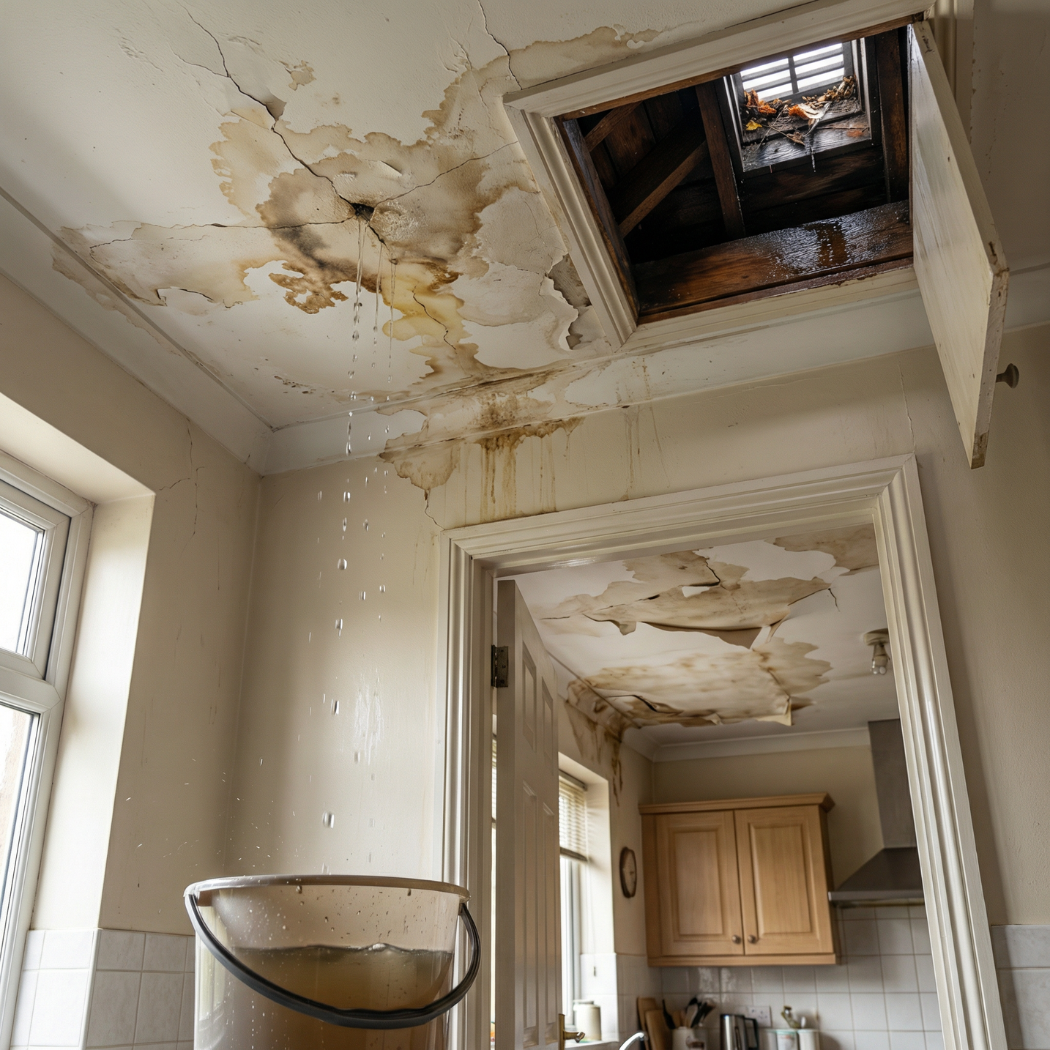
That brown ring above the shower has been there for three months. You painted over it in January and it was back by February. Your neighbor said it was probably the roof. Your brother-in-law said it was condensation. You are not sure who is right, and you cannot afford to fix the wrong thing. This guide explains the two main causes of bathroom and kitchen ceiling stains in Missouri homes, how to tell which one you have, and when the problem traces directly back to a roof vent or pipe penetration that needs to be addressed from the outside.
TLDR: Bathroom and kitchen ceiling stains come from two sources: a true roof leak through a failed vent boot or exhaust hood, or condensation from humid air hitting cold surfaces in your attic. Both cause the same brown ring. The difference shows up in when the stain appears and what the attic looks like above it. A free Roov inspection checks both the roof penetrations and the attic above the wet room and tells you exactly which problem you have and what fixes it.
There are two rooms in every home where ceiling stains are most common, and they are the two rooms that generate the most moisture: bathrooms and kitchens. Every time you take a hot shower or boil a pot of water, you are producing steam and humidity. That humidity has to go somewhere, and in most Missouri homes, it travels toward the roof through vent pipes and fan ducts. Those same pipes and ducts are among the most common leak sources on any roof.
When a ceiling stain appears in one of these rooms, the cause is almost never the shingles. It is almost always something directly above that room, either a failed seal around a plumbing vent pipe, a broken exhaust fan vent cap, or, in many older homes, an exhaust fan that was never connected to the outside at all and has been dumping humid air into your attic for years.
The Most Common Place Homeowners First See a Leak: Bathroom and Kitchen Ceilings
The pattern is familiar across Taney County and all of Southwest Missouri. A yellow or brown ring forms on the ceiling above the shower, or near the light fixture over the kitchen sink. It dries out between rain events. You paint over it and it bleeds back through. Your roofer replaces a few shingles and it still comes back.
The reason it keeps coming back is that the source is not the shingles. Shingles are rarely the origin of bathroom and kitchen ceiling stains. The origin is almost always a penetration point directly above that room, where something passes through the roof deck and the seal around it has either failed from weather exposure or was never adequate to begin with.
Both true roof leaks and condensation problems produce identical-looking ceiling stains. That is the first thing homeowners need to understand: you cannot diagnose the cause by looking at the stain. You diagnose it by understanding when the stain appears, what the weather conditions were, and what the attic looks like above it.
Pro tip: Take a photo of the ceiling stain each time it appears or darkens, and enable the location timestamp on your phone’s camera. Over two or three rain events, this creates a timestamped record that an inspector can cross-reference with local weather data to confirm a rain-correlated pattern definitively.
Pro tip: Before calling anyone, start a simple log. Write down the date each time you notice the stain looks wetter, and note whether it rained in the previous 48 hours. That pattern, rain-related or not, is the single most useful piece of information for diagnosing the source.
Roof Vents and Plumbing Pipes Above Those Rooms
Every bathroom and kitchen in your home has at least one and often two or three penetrations through the roof directly above it. Understanding what each one does explains why they fail and what happens when they do.
A plumbing vent pipe is a vertical pipe that rises from your drain system through the ceiling, into the attic, and out through the roof. Its job is to allow air into the drain system so water flows freely through the pipes. You can see them from outside: they are the dark pipes sticking up through the roof, usually two to four inches in diameter. Where the pipe exits the roof deck, a pipe boot (a rubber-and-metal collar) seals the gap around it. When that boot fails, water enters directly above the room below.
An exhaust fan vent is the duct that connects your bathroom fan or kitchen range hood to the outside. Building science standards and modern building codes require these vents to terminate outside the building, not in the attic. According to Building Science Corporation’s ventilation research, all exhaust fans must vent directly to the outside. In many older Missouri homes, this duct was terminated at an attic gable vent, or worse, terminated in the middle of the attic with no outside exit at all. When an exhaust fan dumps humid air into the attic, that moisture condenses on cold surfaces in winter and saturates insulation and drywall, producing stains that look exactly like a roof leak.
The table below shows the three main roof penetration types found above bathrooms and kitchens, what each one does, and how each one fails.
| Vent Type | What It Does | Where It Exits the Roof | Common Failure Mode |
|---|---|---|---|
| Plumbing vent pipe | Allows air into drain system; balances plumbing pressure | Directly through roof deck; sealed with rubber pipe boot | Boot collar cracks from UV and freeze-thaw; base flange separates from deck; water enters at pipe |
| Bathroom exhaust fan duct | Carries humid air from shower space to outside | Should exit through a metal vent hood on the roof surface | Vent hood cap lifts from wind; back-draft damper fails; duct disconnected in attic; duct terminates in attic without exiting |
| Kitchen range hood duct | Carries cooking steam and grease-laden air outside | Should exit through a dedicated roof cap or wall cap | Roof cap corrodes or lifts; flexible duct disconnects from the boot at the roof exit; cap screen blocks airflow and causes pressure buildup |
Pro tip: A properly functioning exhaust fan back-draft damper should close completely when the fan is off. You can test it by turning the fan off and holding a tissue at the ceiling grille. If you feel air movement coming down through the grille, the damper is not sealing. That means outside air, or attic air in mis-vented systems, is traveling back into the bathroom.
Pro tip: If your bathroom exhaust fan is older than 10 years and you have never confirmed where the duct goes, there is a reasonable chance it is not exiting the roof at all. This is one of the most common hidden problems Roov finds in older Hollister and Southwest Missouri homes.
Roof Leak or Condensation Problem: How to Tell the Difference
This is the question that determines everything: is water coming in through the roof, or is it forming inside the attic from trapped humid air? Both produce brown ceiling stains. They require entirely different fixes.
Signs that point to a true roof leak:
The stain appears or darkens within 24 to 48 hours after a rain event, and you can connect the pattern to rain. The stain grows or drips actively during heavy rain. The drywall is soft or spongy to the touch, indicating sustained water exposure. A flashlight check of the attic shows wet wood on the roof deck near a vent pipe or exhaust hood, and the water trail runs downhill from the penetration.
Signs that point to a condensation problem:
The stain appears or grows in winter, especially after periods of multiple long hot showers, and is not correlated with specific rain events. The attic check shows wet insulation but no clear wet spot or trail at the roof deck. The exhaust fan duct feels damp or is dripping inside the attic. There is visible mold or mildew on the underside of the roof deck in a diffuse pattern rather than a concentrated trail from a specific penetration.
The table below is a side-by-side reference for distinguishing the two causes before a professional inspection.
| Indicator | Points Toward Roof Leak | Points Toward Condensation |
|---|---|---|
| When stain appears | Within 24 to 48 hours after rain | During cold months after heavy shower use; not rain-correlated |
| Season pattern | Consistent year-round whenever it rains | Worse in winter; reduces or disappears in summer |
| Attic appearance | Wet or stained roof deck near a penetration; water trail running downhill from vent | Wet insulation without a clear roof deck entry point; damp or dripping flex duct |
| Drywall texture | Soft, water-saturated, sometimes actively dripping | Often just stained; may feel damp but not actively wet |
| Fan duct condition | Duct properly connected and exiting roof | Duct disconnected in attic or terminating without exterior exit |
| Rain wind direction | Stain worse after wind-driven rain from a specific direction | Not wind-sensitive; pattern follows shower use |
The distinction matters because a condensation problem from a fan venting into the attic will not be fixed by replacing the pipe boot on the plumbing vent. And a failed pipe boot will not be fixed by redirecting the exhaust fan duct. Treating the wrong one leaves the real problem in place and the stain continuing to return.
Pro tip: If you have a wood-frame home built before 1990 and the exhaust fan has never been replaced, there is a meaningful probability the duct was originally run to a gable vent or simply left open in the attic. Original builders frequently took shortcuts with bath fan ducting that were not code violations at the time but create significant moisture problems decades later.
Pro tip: Some households have both problems simultaneously. A failed pipe boot causes rain-correlated stains, and an exhaust fan venting into the attic causes winter condensation stains. They overlap and both show up as brown rings in the same room. This is why a professional inspection that checks both the penetrations from the roof and the duct system from the attic is more reliable than addressing one source without checking the other.
Pro tip: If the stain has a consistent “wet season” pattern, meaning it grows in winter and shrinks in summer, and your bathroom fan is older or was installed by a previous owner without documentation of where it vents, prioritize the attic check first. Exhaust fans terminating in the attic are more common in Southwest Missouri older housing stock than most homeowners expect.
How Roof Vents and Pipe Boots Fail Over Time
The rubber collar on a standard pipe boot is not designed to last the full life of your roof. In Missouri’s climate, UV radiation from summer sun and freeze-thaw cycles through winter combine to degrade the rubber faster than the surrounding shingles age. A typical rubber boot collar can begin cracking within 10 to 15 years, and on south-facing slopes where UV exposure is highest, that timeline can be shorter.
The metal base flange of a pipe boot is more durable, but nails driven through it into the roof deck can back out over time from thermal movement. Each nail that backs out creates a small but direct water path. The sealant applied around the base at installation dries and cracks after 7 to 10 years, and once that sealant fails, water enters around the flange edge rather than through the collar.
Exhaust fan vent caps face different failure mechanisms. The metal caps with flapper dampers that cover bathroom and kitchen fan exits on the roof surface are exposed to wind uplift on every windy day. Over years, the metal corrodes, the hinge on the damper stiffens or breaks, and the mounting flange separates from the surrounding shingles. Once the cap lifts even slightly at the edge, wind-driven rain during Missouri spring storms enters around the base and travels down the duct or directly into the attic.
According to GAF’s rooftop accessories guide for appliance vents, bathroom and kitchen exhaust penetrations are specifically identified as vulnerable points requiring proper rooftop accessories to prevent moisture intrusion. The standard metal or plastic vent caps installed on many older homes do not meet current performance standards and do not pass the 110-mph wind-driven rain resistance testing that modern products are designed around.
The specific failure modes to watch for include: rubber pipe boot collars that appear shrunken, cracked, or no longer sitting flat against the pipe; exhaust vent caps that have a visible gap at the base flange or an obviously corroded or broken damper; and any penetration point where the surrounding shingles look discolored or where granule loss appears in a ring around the fitting, which indicates water has been running around the seal for multiple seasons.
Pro tip: If you have multiple bathrooms and only one has a ceiling stain, note which bathroom the stain is above. The plumbing vent serving the room with the stain is the most likely suspect for a boot-related leak. Matching the stain location to the vent pipe location above it narrows the inspection significantly.
Pro tip: Roof vent caps that service kitchen range hoods accumulate grease residue on the damper flap and screen over time. This buildup can make the damper stick open permanently, allowing cold air back in through the winter, or stick closed, blocking the exhaust and building pressure in the duct system. A range hood vent that you can hear whistling or feel resistance from when the fan runs is a candidate for cleaning or replacement.
Pro tip: Walk around your home after the next hard rain and look up at the roof surface while it is still wet. Active drips running from a penetration point, or a wet shingle pattern radiating out from a boot or vent cap, identify the failing component directly. This is one of the few cases where observing the roof during or immediately after rain provides useful diagnostic information from a ground-level vantage point.
Interior Damage Risk in Bathrooms and Kitchens
Whether the source is a roof leak through a failed boot or condensation from a mis-vented exhaust fan, the interior damage from ignoring it follows the same progression. Both scenarios deposit moisture into drywall and insulation that does not have a path to dry out.
Drywall paper saturates and begins to grow mold within 24 to 48 hours of sustained wetting. Ceiling insulation directly above a wet drywall section absorbs and holds water, which reduces its R-value and creates a continuous moisture reservoir that keeps the drywall wet even after rain stops or showers are no longer being taken. The mold that develops inside the drywall and insulation is not visible from below the ceiling until it has been present for weeks or months, by which point a relatively inexpensive repair has become a drywall and insulation replacement project.
The EPA’s guidance on mold and moisture in homes confirms that mold can begin growing on wet surfaces within 24 to 48 hours and that the key to preventing mold is controlling moisture at the source. Painting over a mold-stained ceiling without addressing the moisture source allows the mold colony to continue growing behind the paint while the visible surface appears dry.
Electrical fixtures are an additional concern in both kitchens and bathrooms. Recessed can lights and exhaust fan units are mounted directly in the ceiling plane. A moisture stain that expands toward a can light is not just a cosmetic problem. It is a potential electrical hazard. Water conducting into a recessed fixture or running along wiring toward the fixture junction creates shock and fire risk. Any moisture stain within two feet of a ceiling-mounted electrical fixture should be treated as urgent.
Real example: A homeowner in Hollister had a persistent brown ring on the master bathroom ceiling that had been painted over twice in five years. An interior painter had told them it was a roof problem. A previous roofer had replaced two shingles above the bathroom and declared the roof fixed. Neither repair addressed the actual source. Roov’s inspection found the exhaust fan duct disconnected in the attic above the bathroom, terminating six inches from the roof deck without exiting. The fan had been pumping humid shower air directly onto the cold roof decking above the bathroom for years, and the condensation ran to the lowest point of the ceiling each winter. Reconnecting the duct to a properly installed roof vent cap solved the stain permanently.
What Homeowners Can Check Safely Before Calling a Roofer
There are several things you can do from inside the home and from the ground that provide useful diagnostic information without any risk of injury or roof damage. None of these replace a professional inspection, but they sharpen the question you bring to the inspector.
From inside the home, note the pattern of the stain. Is it consistently worse after rain events? Does it appear or grow during winter months regardless of rain? Does it follow the shower or cooking schedule of the household rather than the weather calendar? These patterns direct the inspection toward roof penetrations, toward attic condensation, or toward both.
From the attic, if you can access it safely through a pull-down stair or closet hatch, a flashlight check provides the most useful pre-inspection information. Without stepping on any drywall or unsupported insulation, look for wet wood at the roof deck near penetrations, vent ducts that appear to terminate in the middle of the attic space without exiting, insulation that looks flattened and dark from moisture, or visible mold on the underside of the roof sheathing.
The table below shows what each check reveals and when to stop and call a professional.
| What You Can Check | What It Tells You | When To Stop and Call Roov |
|---|---|---|
| Stain pattern versus rain pattern | Points toward roof leak (rain-correlated) or condensation (weather-independent) | If the pattern is unclear after two or three observations, or if you see active dripping |
| Stain location relative to fixtures | Stain near a pipe boot or exhaust vent above points toward a penetration leak | Any stain within two feet of an electrical fixture; call immediately |
| Attic check: duct condition | Disconnected or attic-terminating duct confirms condensation source | If duct inspection requires moving beyond arm’s reach without a stable surface to stand on |
| Attic check: wet deck or insulation | Wet roof deck near a penetration confirms active leak; wet insulation without deck spot suggests condensation | Stop if you see sagging or stained drywall from below while in attic; stop if any wood appears soft or rotted |
| Ground-level observation of vent caps | Lifted, corroded, or missing caps visible from driveway with binoculars | If cap appears obviously failed or separated from deck, call before the next rain event |
Stain pattern versus rain pattern
Points toward roof leak (rain-correlated) or condensation (weather-independent)
If the pattern is unclear after two or three observations, or if you see active dripping
Stain location relative to fixtures
Stain near a pipe boot or exhaust vent above points toward a penetration leak
Any stain within two feet of an electrical fixture; call immediately
Attic check: duct condition
Disconnected or attic-terminating duct confirms condensation source
If duct inspection requires moving beyond arm’s reach without a stable surface to stand on
Attic check: wet deck or insulation
Wet roof deck near a penetration confirms active leak; wet insulation without deck spot suggests condensation
Stop if you see sagging or stained drywall from below while in attic; stop if any wood appears soft or rotted
Ground-level observation of vent caps
Lifted, corroded, or missing caps visible from driveway with binoculars
If cap appears obviously failed or separated from deck, call before the next rain event
Pro tip: Insulate the exhaust duct wherever it runs through unheated attic space. An uninsulated flex duct carrying warm humid bathroom air through a cold attic will have condensation dripping from it before the air even reaches the roof exit. That condensation drips onto the ceiling below, producing stains that are genuinely neither a roof leak nor attic condensation but rather duct condensation caused by inadequate insulation on the duct itself.
Pro tip: If you can safely look at the exhaust fan in the bathroom ceiling from directly below, check whether running the fan produces any drafts in an unexpected direction, or whether the fan housing has any discoloration or moisture marks around it. A fan that vents into the attic will sometimes produce a slight attic smell when running in cold weather, because the cold attic air is being pulled back through the same duct by pressure differential.
How Roov Diagnoses and Fixes These Leaks
When Roov inspects a bathroom or kitchen ceiling stain, the process covers both the roof surface and the attic above the wet room in the same visit. Addressing only one side of the problem is one of the reasons these stains keep returning after repeated contractor visits.
From the roof, Roov inspects every penetration point directly above the affected room: each plumbing vent pipe boot, any exhaust fan vent caps, and the condition of the shingles and flashing in the surrounding area. Pipe boot collars are assessed for cracking, shrinkage, and separation. Exhaust vent caps are evaluated for damper function, base flange condition, and how well the cap integrates with the surrounding shingles.
From the attic, Roov traces the exhaust fan duct to confirm where it terminates, checks for moisture-stained insulation or roof deck in the zone above the ceiling stain, and photographs the duct connection at the exhaust hood to document whether it is properly connected and sealed.
Typical repairs that result from this inspection include pipe boot replacement when the rubber collar is cracked or the base flange has separated; exhaust vent hood replacement when the cap is corroded or no longer seals against wind-driven rain; duct reconnection and sealing when a fan duct has become disconnected in the attic; and in cases where the duct was never connected to an exterior exit, a new roof penetration with proper vent cap and duct routing to take the fan exhaust through the roof surface rather than into the attic.
The table below shows the typical repair scope for the most common findings Roov encounters above bathrooms and kitchens in Southwest Missouri.
| Finding | What It Means | Typical Repair | Approximate Cost Range |
|---|---|---|---|
| Cracked rubber pipe boot collar | Boot has failed from UV or freeze-thaw; water entering at pipe | Replace boot collar and reseal base flange | $350 to $500 |
| Separated boot base flange | Nails backed out; base no longer seals to deck | Remove shingles, replace full boot, reinstall shingles | $400 to $600 |
| Failed exhaust vent cap | Damper broken; cap lifted from deck; corrosion | Replace roof vent cap with properly flashed unit | $350 to $500 |
| Exhaust duct terminating in attic | Fan never connected to exterior; condensation source | Route new duct to exterior; install roof penetration and vent cap | $400 to $700 |
| Disconnected flex duct in attic | Duct separated at a joint; moisture dumping into attic | Reconnect and seal duct; insulate if uninsulated | $200 to $400 |
| Wet insulation above ceiling | Secondary damage from any of the above | Replace saturated insulation after source is fixed | Varies by area |
For the underlying roof repair needs that involve shingle disturbance around penetrations, Roov handles those as part of the same scope so the penetration repair and the shingle work around it are completed together in one visit.
Real Missouri Examples
Real example: A homeowner in Hollister called after a brown ring appeared on the master bathroom ceiling, always after rainstorms. An interior painter had suggested condensation. Roov’s inspection found the pipe boot on the plumbing vent stack directly above the shower had cracked through on the downslope face of the collar. Every rain event pushed water under the base flange and down to the ceiling below. The boot had been in place for 14 years. A boot replacement sealed the leak. The contractor who had previously “fixed the roof” had replaced a field shingle two feet away from the actual source.
Real example: A homeowner in Branson had moisture stains appearing on the ceiling in the second bathroom starting every November and clearing up by April. The pattern was strictly seasonal with no rain correlation. Roov’s attic inspection found the bathroom exhaust fan duct ended at a flex duct connector inside the attic with no exit through the roof. The previous owner had installed the fan but never connected the exterior vent cap. For three winters, the bathroom fan had been dumping shower steam directly onto the cold roof deck above that room. A new roof penetration with a proper vent cap and insulated duct connection eliminated the problem entirely.
Real example: A homeowner in Springfield had a ceiling stain near a kitchen can light that appeared after any significant wind event, not after calm rain. The location near the electrical fixture made this a priority call. Roov’s inspection found the kitchen range hood duct connected to a roof cap whose base flange had lifted on the windward side. Wind-driven rain was entering at the gap between the cap base and the shingles and running down the duct directly above the can light. A new GAF Master Flow roof cap with proper flashing integration replaced the original corroded unit. The can light housing was checked for moisture exposure before declaring the repair complete.
Real example: A homeowner in Nixa had both problems simultaneously. Rain-correlated stains appeared in the main bathroom after every storm, and seasonal condensation stains appeared in the same room every winter. Roov found a cracked pipe boot on the plumbing vent directly above the bathroom and an exhaust fan that vented into the attic through a disconnected flex duct. Two separate repairs addressed both sources. The homeowner had spent two years assuming it was one problem when it was always two.
Real example: A homeowner in Forsyth noticed soft drywall on the kitchen ceiling near the exhaust hood over the stove, only visible after hot meal preparation, not after rain. Roov confirmed the range hood duct was connected to a roof cap whose back-draft damper had frozen open from a failed hinge. Cold outside air was flowing back into the duct and condensing on the warm underside of the kitchen ceiling when cooking. Replacing the duct cap with a properly functioning damper eliminated the problem.
Frequently Asked Questions
Q: Why is my bathroom ceiling leaking but only sometimes?
The intermittent pattern is the most important diagnostic clue. If the stain appears or worsens after rain events, suspect a failed pipe boot or exhaust vent cap. If it appears after multiple long showers, particularly in cold months, suspect an exhaust fan that is venting into the attic rather than outside. Some homes have both problems, which is why the stain seems to have no clear single trigger. A professional inspection that checks both the roof penetrations and the attic duct routing is the only way to diagnose intermittent stains accurately.
Q: Can a bathroom fan that vents into the attic cause a ceiling leak?
Yes, and this is one of the most commonly misdiagnosed ceiling stain sources in older Southwest Missouri homes. A fan venting into the attic deposits humid air onto cold surfaces during winter. That moisture condenses, saturates insulation, and drips onto the ceiling drywall below, producing stains that look identical to a roof leak. The fix is not a roofing repair. It is routing the exhaust duct through a proper exterior vent cap, which in most cases requires a new roof penetration.
Q: Do I need a roofer or a plumber for a vent pipe leak?
A roofer, specifically one with experience in roof penetrations. A plumbing vent pipe passes through the roof sealed by a pipe boot, which is a roofing component, not a plumbing component. The plumbing pipe itself is not the source of the leak. The failed seal around it at the roof deck is. Roov handles both the boot replacement and the shingle work around it in a single visit.
Q: How much does it cost to fix a leaking vent pipe boot?
A single pipe boot replacement typically costs $350 to $500 including removal of the surrounding shingles, installation of a new boot, and reinstallation of the shingles. An exhaust vent cap replacement runs similarly, depending on whether duct reconnection is also required. These are among the least expensive roof repairs available and among the most cost-effective given what a bathroom or kitchen ceiling repair costs once moisture damage has progressed to the point of drywall replacement and mold remediation.
Q: Is this type of leak covered by homeowners insurance?
If the leak is from a failed pipe boot or exhaust vent that was caused by a sudden storm event, such as hail cracking a boot collar or wind separating an exhaust cap, there may be coverage depending on your policy. Gradual wear and age-related failure are typically maintenance items that insurers exclude. Roov documents the cause in every inspection report, which helps clarify whether the damage has a storm-related origin.
Q: Will painting over the stain fix the problem?
No. Painting over a moisture stain without addressing the source is the single most common mistake homeowners make with bathroom and kitchen ceiling stains. The stain returns because the moisture continues to enter. More importantly, the drywall and insulation behind the paint continue to accumulate moisture and mold even when the surface looks covered. Every paint layer added over an active moisture stain increases the eventual repair scope. Fix the source, allow the ceiling to dry completely, apply a stain-blocking primer, and then paint.
Q: How do I know if my bathroom fan is actually venting outside?
With the fan running, go to the roof and check whether the exhaust cap flap is opening. If you cannot access the roof, hold a tissue under the fan grille while it runs: it should be clearly pulled toward the fan, indicating suction. Then check the attic if accessible: a properly connected duct runs from the fan housing through insulation to the roof deck exit. If you cannot locate where the duct goes in the attic, assume it needs professional evaluation.
Q: What happens if I ignore this kind of moisture stain?
The trajectory is consistent: soft drywall, mold in insulation, potential structural damage to the ceiling framing in severe cases, and eventual electrical risk if moisture reaches ceiling fixtures. What costs $400 to $600 to fix at the source costs $2,000 to $5,000 or more once drywall, insulation, and mold remediation are added to the scope. The stain is a warning, not just a cosmetic problem.
Key Takeaways
- Two causes, one stain. Bathroom and kitchen ceiling stains come from roof leaks through failed penetrations or condensation from fans venting into the attic. Both look identical from below.
- Vent pipes need proper pipe boots. The rubber collar on a plumbing vent boot typically lasts 10 to 15 years in Missouri’s climate. A failed boot is one of the most common sources of bathroom ceiling stains.
- Exhaust fans must exit the roof. A bathroom fan that vents into the attic rather than outside deposits moisture directly onto cold surfaces in winter, producing condensation stains that are often mistaken for roof leaks.
- Timing is the best diagnostic tool. Rain-correlated stains point toward penetration leaks. Seasonal winter stains with no rain correlation point toward condensation from attic-terminating ducts.
- Painting over the stain is not a fix. It hides the evidence while the source continues to deposit moisture into the structure.
- Electrical fixtures and moisture are an urgent combination. Any ceiling stain within two feet of a can light or fan housing is a priority repair, not a watch-and-wait situation.
- A proper inspection checks both sides. An inspection that only looks at the roof surface or only looks at the attic misses the combined picture. Roov checks both in every free inspection above a wet room.
Bathroom or Kitchen Ceiling Spot Driving You Crazy?
If you have seen the same stain painted over and return, or watched a roofer replace shingles while the spot kept coming back, the source was never addressed. Roov serves Hollister and all of Taney County, along with Branson, Forsyth, Nixa, Springfield, and communities across all eight counties of Southwest Missouri. Every free inspection above a wet room includes the roof penetrations, the pipe boots, the exhaust vent caps, and the attic duct routing so you get a complete roof inspection and a clear answer about what is actually causing the problem and what actually fixes it.
Call 417-370-1259 or schedule your free inspection online.
Roov | Roofing with a Purpose | Serving Southwest Missouri